
In the UK a pizzeria with tables and a pizza takeaway are not the same thing in planning law. One sits inside Use Class E, the other is sui generis and needs permission in its own right. That distinction shapes the site search, the licensing, the trading hours and the budget. What follows sets out the process in England, and flags where the other nations differ.
How to open a pizzeria in the UK, step by step
The checklist, in the order openings usually run:
- Format and split of trade decided
- Planning position checked before any lease
- Catchment and delivery radius mapped
- Building surveyed for power, gas, flue and cold storage
- Oven chosen, and checked against smoke control rules
- Every pizza costed by sales channel
- Kitchen planned around the dough
- Lease negotiated with a planning condition
- Business, VAT, food registration and licences in place
- Direct ordering built and a soft launch run
Pizza sits across three regulated activities. It is a food business, so it registers with the local authority. It is a hot food operation, so planning treats it differently from a café. And it commonly trades after 11 pm, which makes it licensable under the Licensing Act 2003 whether or not alcohol is sold. A pizzeria can clear the first and fail the other two, which is why the sequence below starts with the use class.
What is a pizzeria business?
A pizzeria is a food business selling pizza for consumption on the premises, for collection or for delivery. UK planning law does not recognise the word, and classifies premises by where the food is eaten. A pizza restaurant, where consumption is mostly undertaken on the premises, falls within Use Class E(b). A pizza takeaway, where consumption is mostly undertaken off the premises, is sui generis, outside every use class, under the Use Classes amendment in force since 1 September 2020. The label on the door is irrelevant; the split of trade decides it.


Pizza GoGo
Pizza takeaway, the established way
- Pizza
- 100
- Liquid capital: £33000

Pizza Hut
Delivery and dine-in, under two separate businesses
- Pizza
- Liquid capital: £
Fireaway
Fresh, fast, fired pizza
- Pizza
- Liquid capital: £100000
Domino's Pizza
Pizza delivered, from 1,410 stores in the UK
- Pizza
- 1 410
- Liquid capital: £70 000
How to open a pizzeria in the UK, step by step
1. Settle the format and the split of trade
Four formats dominate: the sit-down restaurant, the collection and delivery takeaway, the delivery-led kitchen with no shopfront, and the mobile oven. The choice sets the use class, the licensable hours and the unit size. Operators expecting delivery to grow from a sideline into the majority of turnover are describing a change of use, not of emphasis.
2. Check the planning position before signing anything
An existing Class E unit carries no right to run a pizza takeaway. Moving to sui generis requires a planning application, as does most external work: the flue, the ducting and any shopfront alteration. Many councils restrict new hot food units near schools through supplementary planning documents, so refusal is a live possibility. The permitted development route runs one way only: a takeaway may change to Class E without permission, but not the reverse.
3. Map the catchment and the delivery radius
A pizzeria lives on the population within a short drive and the competition already serving it. Malone has described choosing a village with around 50,000 people within five miles and almost no competition beyond Domino’s and Papa Johns, then delivering to the surrounding villages to widen the reach. The delivery radius is set by eating quality, not the map: pizza degrades quickly in a box, and a customer who receives it cold does not reorder.
4. Survey the building before the lease
- Electricity: electric deck ovens commonly need three-phase power, which many small high street units lack, and an upgrade takes weeks
- Gas capacity: a deck or conveyor oven can exceed what the existing meter and pipework deliver, not just whether gas is present
- Flue termination: height and position relative to neighbouring windows is what turns a consent into a refusal
- Cold storage: dough needs far more refrigerated space than most fit-outs allow for
- Collection space: drivers and customers waiting for orders need somewhere that does not block service
5. Choose the oven, and check it is legal on the site
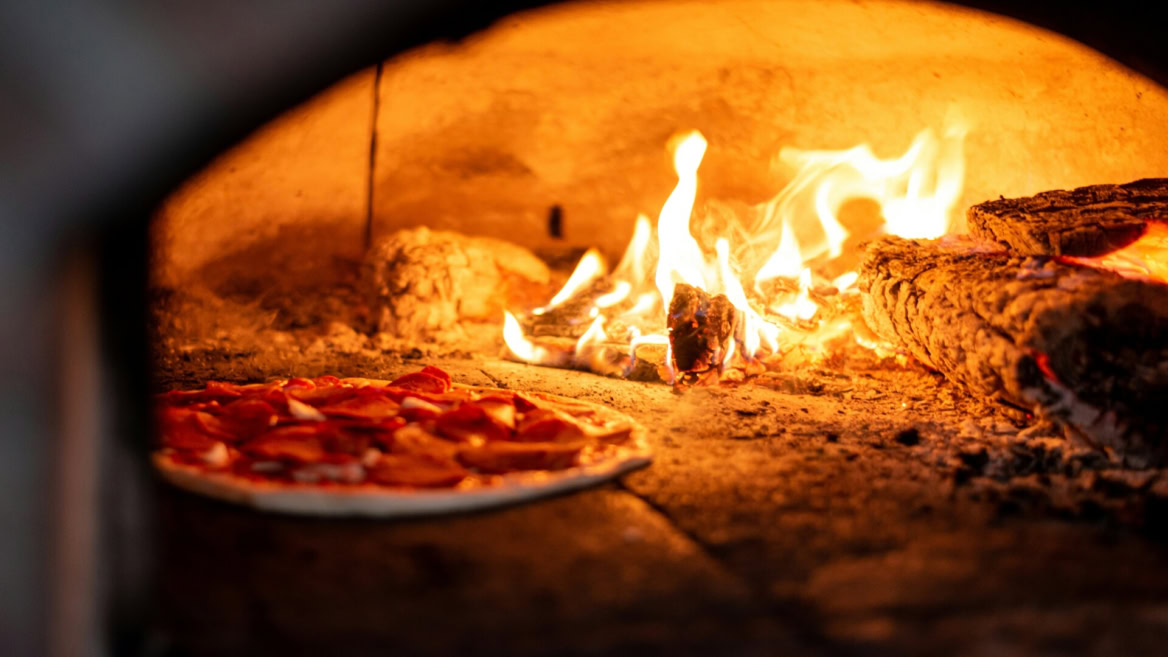
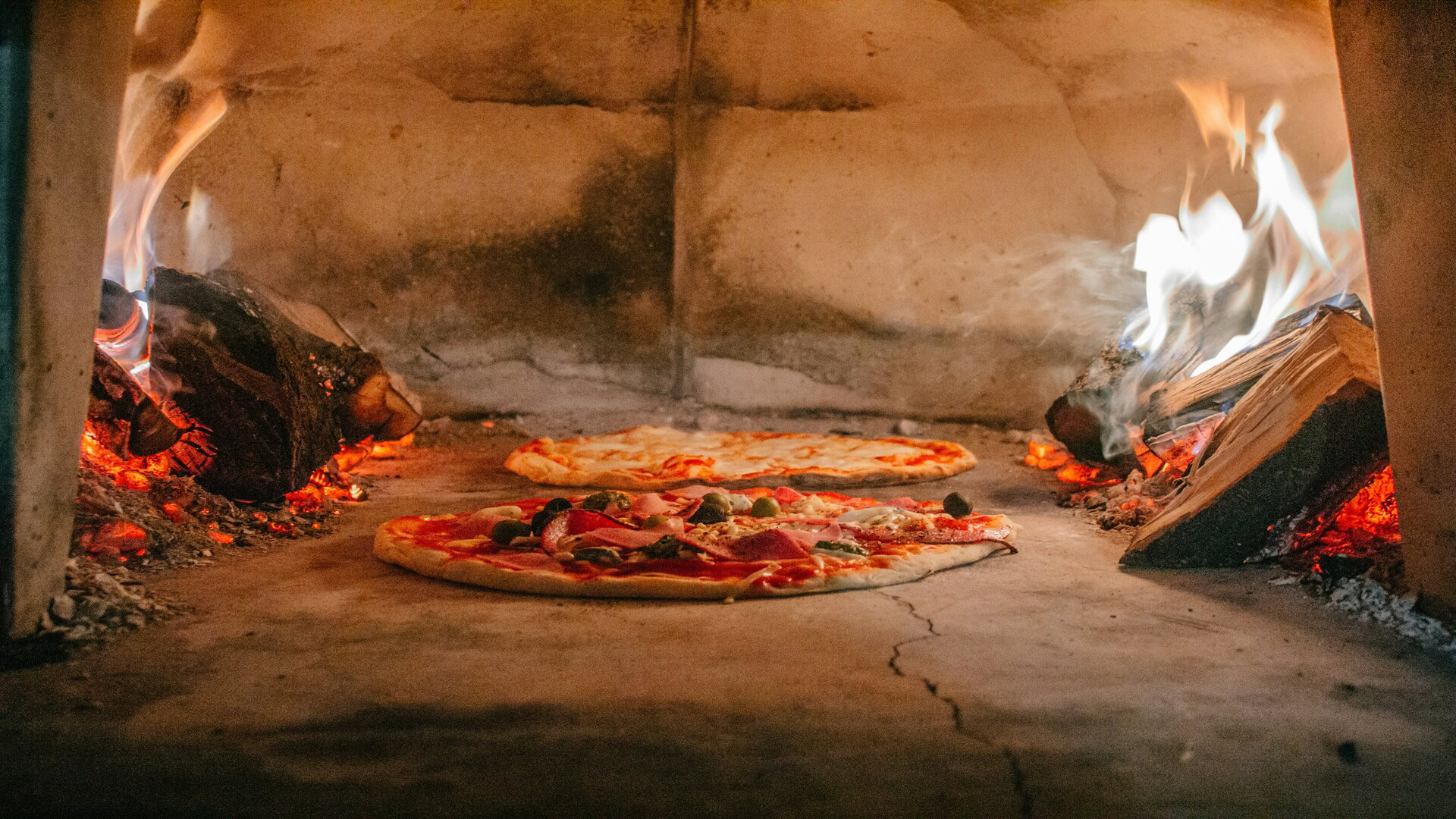
The oven fixes output per hour, the skill the kitchen needs and the extraction the building must carry. Under the Clean Air Act 1993, wood is an unauthorised fuel inside a smoke control area, and most major UK cities are wholly or partly designated. Burning it there is lawful only in an appliance Defra has exempted, and its list includes specific commercial pizza ovens by name, some of which must be brought up to temperature on gas before wood goes in. Emitting smoke from a chimney in a smoke control area carries a penalty of up to £300. Whatever the fuel, a deck or wood oven takes hours to heat, which is energy spent before the first order.
6. Cost every pizza by sales channel
Hot food is standard-rated at 20% whether eaten in or taken away, so a sixth of every till price belongs to HMRC once a pizzeria is registered. Delivery commission then comes out of what is left. The worked example below uses illustrative ingredient inputs and Uber Eats’ published UK fees:
| Margherita at a £12.00 menu price | Collection | Self-delivery via app | App delivers |
|---|---|---|---|
| VAT at 20% | £2.00 | £2.00 | £2.00 |
| Dough, sauce, mozzarella, toppings, box | £2.70 | £2.70 | £2.70 |
| Platform fee on £12.00 | None | £1.56 (13%) | £3.60 (30%) |
| Left before labour, energy, rent and the driver | £7.30 | £5.74 | £3.70 |
Illustrative ingredient inputs, L’Express Franchise, October 2026. Platform fees: Uber Eats UK pricing page, consulted October 2026. Self-delivery also carries the driver’s cost.
The same pizza leaves roughly half as much when the app delivers it as when it is collected. Operators commonly respond with a separate, higher delivery menu, a minimum order value and sides that travel well, since the fee is charged on the whole order.
7. Plan the kitchen around the dough
A cold-fermented dough sits for 24 to 72 hours before use, which means refrigerated space sized to peak covers plus the days in front of them. Dough is also where the daily loss sits: balls prepped for a Friday that does not arrive go in the bin, so dough count is forecast from the previous weeks, the weather and the fixture list. Surplus dough can become a product of its own; Village Pizza Kitchen fries it into a cinnamon-sugar dessert on its menu. Flour strength and the water content of the mozzarella both change the product, so specifications are fixed with suppliers rather than left to the delivery van.
8. Negotiate the lease with a planning condition
- Conditional on planning: a letting conditional on the change of use protects a tenant who would otherwise hold a unit they cannot trade from
- Repairs: most small units are let on a fully repairing and insuring basis, creating a dilapidations liability at expiry
- Security of tenure: in England and Wales the Landlord and Tenant Act 1954 Part II confers a renewal right unless the lease is contracted out
- Flue consent: from the landlord as well as the planning authority
- Assignment terms: these decide whether anyone can buy the business later
9. Register the business, the food operation and the licences
- Food business registration: with the local authority at least 28 days before trading. Free, and it cannot be refused
- Late night refreshment: a premises licence for hot food between 11pm and 5am, with alcohol added to the same licence if sold
- VAT: registration once taxable turnover passes £90,000; a pizzeria has none of the zero-rating a bakery works with
- Allergens: a documented food safety system covering the 14 named allergens, with gluten-free only offered where separate preparation space and utensils exist
- Fire and insurance: a fire risk assessment under the Regulatory Reform (Fire Safety) Order 2005, employers’ liability, and motor cover that expressly includes food delivery where drivers are in house
- Funding: Start Up Loans lends up to £25,000 per applicant at a fixed 7.5%, unsecured
10. Build direct ordering and soft launch
A Google Business Profile that links to a pizzeria’s own ordering page, rather than an app listing, sends searchers for “pizza near me” to the cheapest channel. Leaflets in every delivery box, a loyalty reward for ordering direct and a collection discount move app customers across over time. A quiet week at reduced capacity before the official launch lets the kitchen find its rhythm before the food hygiene rating and the first reviews are recorded.
The practical difficulties operators report
- Planning refusal : hot food takeaway is the use councils most actively restrict, through supplementary planning documents limiting new units near schools or on health grounds
- Licensing objections : late night refreshment applications attract representations from residents, environmental health and the police, and the hours granted may be shorter than those sought
- Platform dependence : commission is charged on order value, so a delivery-led model trades margin for reach and the platform owns the customer relationship
- Labour cost : the 18 to 20 band rose 8.5% to £10.85 an hour on 1 April 2026, the steepest of the four bands, on a trade staffed largely by that age group
- Occupancy cost reset : the 2026 revaluation gave every property in England a new rateable value from 1 April 2026, at the same time as the multipliers changed
- Two nights carry the week: Friday and Saturday evening take a disproportionate share of orders, so staffing follows the peak, and fixtures move demand sharply
- The pizzaiolo is a single point of failure: in a pizzeria, skilled oven staff are scarce, and one person’s holiday is a capacity problem
- Menu length is a stock decision: every extra topping is another line to hold, rotate and throw away
- Cheese drives food cost: Domino’s has linked its franchisees’ food costs to the milk market, which a single site cannot hedge
What the trading week actually looks like
Pizza demand is not spread evenly, and the shape of it drives almost every operational decision.
- Friday and Saturday evening carry a disproportionate share of the week. Staff to the peak or lose the peak; quiet midweek is a different business
- Fixtures and broadcasts move demand sharply, so the rota follows the football calendar as much as the trading calendar
- Seasonality cuts both ways. Delivery-led sites dip when the weather is good; university towns empty for a third of the year
- The pizzaiolo is a single point of failure. Skilled oven staff are scarce, one person can be the whole product, and their holiday is a capacity problem rather than a rota problem
- Menu length is a stock decision, not a marketing one. Every additional topping is another line to hold, rotate and throw away
- Drinks carry the margin in dine-in. The pizza brings people through the door; the drinks list is where the gross profit is
Delivery is a separate business
For many pizzerias delivery is the majority of turnover, and it behaves nothing like the counter.
- The product has a short window. Pizza degrades quickly in a box, so eating quality, not the map, should set the delivery radius
- Commission is charged on order value, including any discount you funded, which changes the arithmetic of a promotional menu
- The platform owns the customer. Building a direct ordering channel from opening is far cheaper than trying to reclaim it in year three
- Rider status is a live question: employed, engaged as workers, or reached through a platform, each with different obligations
- Extraction noise, not customers, generates complaints after 11pm, and so do rider movements in a residential street
Types of pizzeria business
- Pizza restaurant, sit-down : Class E(b), the highest fit-out and rent, and the only format where the dining room earns
- Pizza takeaway, collection and delivery : Pizza takeaway, collection and delivery : sui generis, smaller unit, most exposed to planning refusal, and the format most of the fast food franchises recruiting in the UK are built around
- Delivery-led kitchen : no shopfront and no passing trade, so turnover depends on platform visibility and the commission that comes with it
- Mobile or event oven : a trailer or van, registered like any food business, with no lease and no use class question
- Slice or counter format : sold by the slice on high-footfall pitches, closer to a bakery counter than to a restaurant
How much does it cost to open a pizzeria in the UK?
No official UK average start-up cost exists, and there is no disclosure filing to consult, because the UK has none. What can be stated precisely is the cost of the permissions themselves, which most published estimates leave out.
| Item | Published figure |
|---|---|
| Food business registration | Free, at least 28 days before trading, and it cannot be refused |
| Planning application for a material change of use | £610 from 1 April 2026, following the annual CPI indexation of 3.8%. The Planning and Infrastructure Act 2025 introduced powers for local fee setting, consulted on in 2026, which would make the national figure a default rather than a fixed price |
| Premises licence, grant or variation | Banded on rateable value: £100 Band A (no rateable value up to £4,300) rising to £635 Band E (£125,001 and above), then an annual fee of £70 to £350. Set by the Licensing Act 2003 (Fees) Regulations 2005 |
| Personal licence for the named holder | £37, where alcohol is sold |
| Business rates | Rateable value multiplied by the applicable multiplier: 38.2p small business retail, hospitality and leisure, 43.0p standard RHL for 2026/27 |
| Total start-up | Not published: no official UK average, and no public entry figures were found for the three main pizza franchise brands in the UK |
The lines that move a start-up budget most are:
- The site and the lease : any premium, the rent deposit, and on an FRI lease the repairing obligation and dilapidations at expiry
- The oven, the extraction and the kitchen : the flue and ducting frequently cost more than the oven, and both need consent first
- Professional fees on the application : drawings, and in contested cases a noise or air quality assessment
- Staff : the National Living Wage is £12.71 an hour for those aged 21 and over from 1 April 2026 and £10.85 for 18 to 20 year olds, plus employer National Insurance at 15% above £5,000 a year per employee, less the £10,500 Employment Allowance, and a 3% employer pension minimum
- Delivery : vehicles and insurance in house, or commission on every order
- Working capital : the months to settled trade
Good to know
The statutory wording that decides a pizzeria’s planning position is mostly undertaken off the premises. A restaurant doing some collection trade normally stays within Class E. Once the majority of the food leaves the building the use is sui generis, whatever the signage says. Three consequences follow. A unit advertised as a former restaurant carries no takeaway rights.
A business whose delivery share grows past halfway can drift into a different use class without anyone applying for anything, which is where enforcement becomes possible. And the permitted development route runs one way only: a hot food takeaway may change to Class E without permission, but a Class E unit cannot become a takeaway that way. Wales and Scotland classify hot food takeaways separately.
Pizza franchise opportunities in the UK
Franchising in the UK is governed by general contract law, which leaves the franchise agreement carrying the weight a disclosure document carries in the United States. There is no franchise statute, no register and no statutory pre-contract disclosure requirement, and the British Franchise Association’s Code of Ethics binds its voluntary members rather than the market. Pizza is where that absence shows most clearly: the brands are household names and the figures attached to them online are not theirs.
- Domino’s : operates in the UK through a franchised estate held by a listed master franchisee, and recruits experienced multi-unit operators rather than first-time owners. No public recruitment page carrying entry figures was found
- Papa Johns : franchises in the UK, but took a corporate-owned restaurant portfolio in 2023 while repositioning the market. No UK entry figures are published, and the widely circulated numbers come from its US disclosure document, which has no application here
- Fireaway : a UK-founded fast pizza brand that has grown quickly through franchising. No entry terms were found on its own site, and the third-party material circulating about it includes weekly turnover and net profit claims that no regulator has checked
For each of the three, no public page carrying UK entry figures was found. Numbers circulating elsewhere are third-party estimates or, in Papa Johns’ case, drawn from a US filing with no application here. That a brand franchises somewhere does not make it open to an applicant here, a distinction covered in what a franchise is.
Editor’s tip
Earnings claims deserve particular scepticism here. Sponsored articles about UK pizza franchises circulate figures such as an average weekly turnover and a net profit percentage per store. Those numbers come from the franchisor’s own marketing, are not audited, and describe stores that already exist rather than the one being sold. The UK has no equivalent of the US disclosure document, so there is no filing to check them against.
The practical difficulties operators report
- Planning refusal : hot food takeaway is the use councils most actively restrict, through supplementary planning documents limiting new units near schools or on health grounds
- Licensing objections : late night refreshment applications attract representations from residents, environmental health and the police, and the hours granted may be shorter than those sought
- Platform dependence : commission is charged on order value, so a delivery-led model trades margin for reach and the platform owns the customer relationship
- Labour cost : the 18 to 20 band rose 8.5% to £10.85 an hour on 1 April 2026, the steepest of the four bands, on a trade staffed largely by that age group
- Occupancy cost reset : the 2026 revaluation gave every property in England a new rateable value from 1 April 2026, at the same time as the multipliers changed
- Two nights carry the week: Friday and Saturday evening take a disproportionate share of orders, so staffing follows the peak, and fixtures move demand sharply
- The pizzaiolo is a single point of failure: in a pizzeria, skilled oven staff are scarce, and one person’s holiday is a capacity problem
- Menu length is a stock decision: every extra topping is another line to hold, rotate and throw away
- Cheese drives food cost: Domino’s has linked its franchisees’ food costs to the milk market, which a single site cannot hedge
The bottom line
Opening a pizzeria in the UK runs through the same sequence whatever the format, but the order matters more here than in most food categories: format, then planning, then site, then licensing, then fit-out, then staff. The permissions are cheap to apply for and expensive to be refused. Anyone weighing the franchised route against an independent one can compare what brands publish across the UK franchise directory. No official UK average start-up figure exists, and no public entry figures were found for the main pizza franchise brands either.
Frequently asked questions about opening a pizzeria in the UK
It depends on where the pizza is eaten. In England a restaurant selling mainly for consumption on the premises falls within Use Class E(b), so taking over an existing Class E unit does not normally need permission for the use itself. A premises selling hot food mostly for consumption off the premises is sui generis, outside every use class, and moving to that use requires a planning application. External works such as an extraction flue usually need permission separately.
The rating covers three things: hygienic food handling, the condition of the premises, and confidence in management. The third is the one operators lose marks on, because it’s about your documented food safety system and records rather than how clean the kitchen looks on the day. Have the paperwork in place and up to date before your first inspection, not after.
Buying gets you the fit-out, the extraction consents and a trading history, which removes the two biggest sources of delay and refusal. It also means inheriting a lease you didn’t negotiate, a hygiene rating you didn’t earn and whatever reputation exists locally. Starting fresh costs more time and carries planning risk, but everything is yours to specify.
Less front of house than people expect and more back of house. Dough storage, refrigeration, prep space and the oven’s clearances eat the plan fast, and a delivery-led model needs a collection area that doesn’t block service. Measure the kitchen you need first and treat the dining room as what’s left.
Employers’ liability is a legal requirement once you have staff, and public liability is expected by most landlords. Beyond that, the ones operators wish they’d taken are business interruption and equipment breakdown, because an oven failure on a Friday is a lost weekend and an extraction fire can close you for months.
Rarely at the start. Midweek trade can cost more in staff, energy and oven ramp-up than it brings in, and the oven burns energy from the moment you fire it whether or not anyone orders. Many operators trade Wednesday to Sunday until the weekday demand justifies itself.
Nobody can give you a figure, but the shape of it is predictable: a deck or wood oven takes hours to reach temperature and holds it all service, so a meaningful part of the daily energy bill is spent before the first sale. Ask any supplier for the consumption figures and model them against your actual opening hours.
If you’re going to offer it, yes in practice. Flour is airborne and a shared prep bench is a genuine cross-contamination risk, so it means separate preparation space, utensils and handling procedure. Offering gluten-free casually, without that, is the version that causes harm.