
The VAT rate on a cold bubble tea sold to take away has never been settled. It is a beverage, and beverages are standard-rated, unless the drink counts as tea, in which case it is zero-rated. The Association of Taxation Technicians asked HMRC for guidance in August 2024.
Opening a bubble tea shop needs no licence. There is no register, no inspection to pass before trading and no permission to apply for beyond planning. What there is instead is a tax question worth 20 points of margin on the main sales channel, a packaging regime that differs in all four nations, and a franchise market where the published numbers contradict each other. Food law, tax and company registration are UK-wide. Business rates and planning are England only, and the sections below say so where it matters.
What is a bubble tea business?
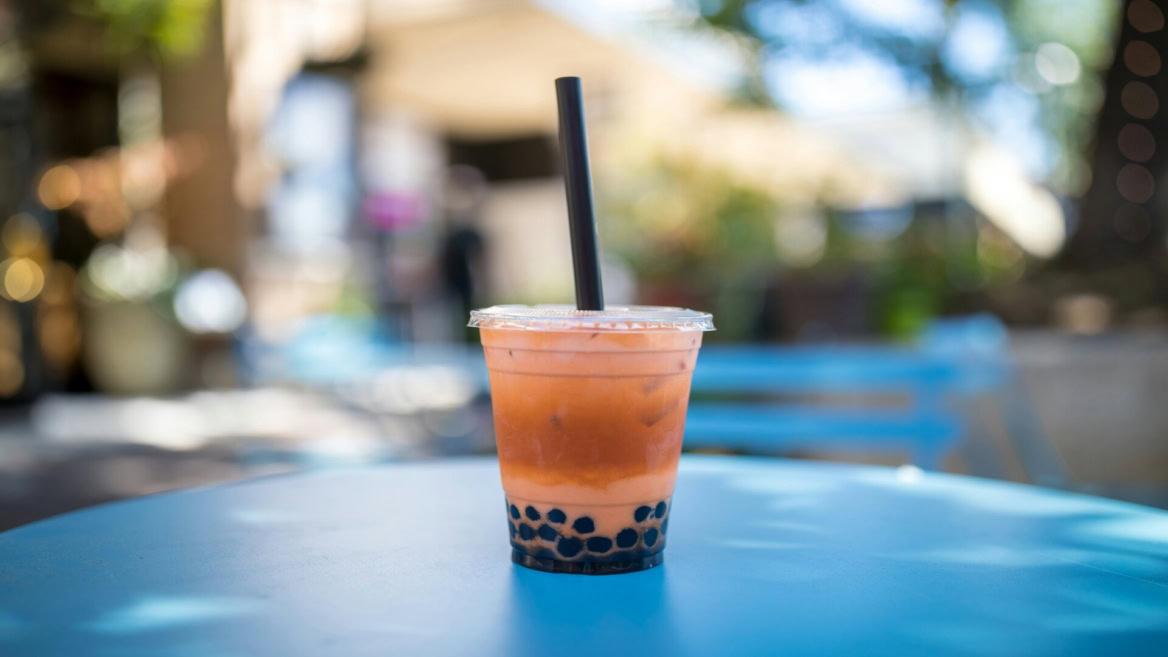
A bubble tea business sells tea-based drinks made to order with chewy tapioca pearls or similar toppings, usually from a small unit or kiosk, and in the UK it is a food business that must register with its local authority but needs no trading licence. The drink is built from brewed tea, milk or fruit, sugar syrup and toppings, sealed in a cup with a film lid and drunk through a wide straw. It was developed in Taiwan in the 1980s and arrived in the UK comparatively recently.
Commercially the format is small footprint, high transaction count and young customers. Operationally it is closer to a coffee shop than a restaurant: limited cooking, heavy equipment dependence and a supply chain that runs largely on imported powders, syrups and pearls. The premises and fit-out decisions run close to those in how to open a coffee shop in the UK.
How to open a bubble tea shop in the UK, step by step
The absence of a licensing regime moves the work forward rather than removing it. Nothing stops the doors opening, so the decisions that matter, on VAT treatment, packaging and supply, all have to be right before the first cup is priced.
What a bubble tea shop needs in place before it trades:
- Food business registration with the local authority, made at least 28 days before opening
- A written food safety management system based on hazard analysis
- A decision on the VAT treatment of each drink, and a till configured to match
- Confirmation from the council that the unit’s planning use covers the business
- Packaging and straws that comply in the nation where the shop trades
- Allergen information for every drink and topping, ready before the counter opens
Register the food business
Registration goes to the council covering the premises, is free, and is due 28 days before opening. The Food Standards Agency states that trading without it is an offence. Registration cannot be refused, which is what separates this sector from care, childcare or animal boarding: the council records the business and inspects it, but it does not decide whether it may exist.
Settle the VAT position before setting prices
Food and drink start out zero-rated under group 1, schedule 8 of the VAT Act 1994, but excepted item 4 pulls “other beverages” back to standard rate. Overriding item 4 then pushes tea, maté, herbal teas and similar products back to zero. Anything sold in the course of catering is standard-rated regardless, which covers drinks consumed on the premises and anything sold hot to take away.
So bubble tea drunk in, or sold hot, is standard-rated at 20%. The open question is cold takeaway, where the drink is zero-rated only if it qualifies as tea. Writing for the Association of Taxation Technicians in August 2024, Emma Rawson set out the three tests drawn from the guidance and case law: the ingredients, whether the drink is made by steeping or brewing leaves, and whether an ordinary consumer sees it as an alternative to tea or as a soft drink.
The precedent is not encouraging for a blanket claim. In Snapple Beverage Corporation, premade iced tea was held to be standard-rated, and Business Brief 14/1994 says overriding item 4 exists to relieve ordinary tea and substitutes for it, not preparations that compete in the soft drinks market. Rawson’s conclusion was that no blanket answer works and each product may have to be considered on its own merits. A drink built from brewed tea that has cooled may qualify; one built from flavoured powder probably does not.
Find a unit and check its planning use
Bubble tea suits small units, kiosks and shopping centre pitches, and the sector has also used converted containers. In England, shops, cafés and restaurants sit inside Class E of the use classes, so a unit already trading as one of those is usually the simplest starting point, and the council confirms whether the intended use needs permission. Seating changes the VAT treatment of every drink sold to a customer using it, so the decision about whether to put chairs in is a tax decision as well as a design one, the same trap that catches bakeries adding tables, as how to open a bakery in the UK sets out.
Buy the equipment the format needs
The kit list is short but specific: a cup sealing machine, tea brewers, a boba cooker or rice cooker for the pearls, a fructose or syrup dispenser, a shaker station, refrigeration and an ice machine. The sealed lid is what lets the drink be shaken and carried. Water supply, drainage and power capacity decide whether a given unit works.
Set up the supply chain
Tapioca pearls, jellies, syrups, powders and sealing film are largely imported, and the supply chain is the reason many independents join a network rather than buy direct. Imported food carries traceability and labelling duties, and a shop buying through a wholesaler inherits the paperwork rather than escaping it. Shelf life on cooked pearls is measured in hours, which shapes the daily prep routine.
Choose packaging that is legal where you trade
Single-use plastics rules are devolved and they are not the same. England bans the supply of single-use plastic straws to end users under regulations in force since 1 October 2020, with an exemption for catering establishments. Scotland runs the same structure under its own 2021 regulations, in force from 1 June 2022 and fully effective from 12 August 2022, with a fine up to level 5 on the standard scale. Wales and Northern Ireland legislate separately again.
Good to know
The straw exemption is narrower than it sounds. A catering business in England or Scotland may still hand over a single-use plastic straw with a drink for immediate consumption, but only if the straws are kept where customers cannot see them or help themselves, and only when the customer asks. Offering one is an offence. For a drink that cannot be consumed without a wide straw, that turns the default into a non-plastic straw and makes the alternative a stock item kept behind the counter.
Write the allergen and food safety system
Food businesses must put in place and maintain procedures based on hazard analysis and critical control point principles, and the FSA publishes Safer Food, Better Business free for small caterers. Allergens matter more here than the menu suggests: milk, soya and nuts run through the toppings and the non-dairy alternatives, and drinks made to order are not prepacked, so the information has to be available and signposted at the counter rather than printed on a label.
Prepare for the inspection and the rating
Registration triggers a local authority inspection. In England, Wales and Northern Ireland that produces a Food Hygiene Rating Scheme score from 0 to 5, published on the FSA website. Scotland runs the Food Hygiene Information Scheme, with a result of Pass or Improvement Required. Displaying the sticker is a legal requirement in Wales and Northern Ireland and voluntary in England.
Recruit and train for peaks
Trade concentrates into afternoons, weekends and school holidays, and the build time per drink is longer than a coffee. Staffing is therefore a rota problem rather than a headcount problem, and the National Living Wage of £12.71 an hour from 1 April 2026 applies to anyone aged 21 and over, with £10.85 for 18 to 20-year-olds and £8.00 for under 18s and apprentices.
Types of bubble tea business
The format decides the capital, and in this sector the smallest formats are the ones the networks push hardest.
| Format | What it involves |
|---|---|
| High street unit | Full shop with seating. Seating makes every drink sold to a seated customer standard-rated |
| Kiosk or mall pitch | Small footprint, licence to occupy rather than a lease, turnover rent common |
| Container or market stall | Lowest fit-out, seasonal exposure, power and water are the constraints |
| Counter inside another business | A concession within a restaurant, shop or venue, sharing rent and staff |
| Franchised site | Brand, supply chain and fit-out specification, against a fee and ongoing royalties |
How much does it cost to open a bubble tea shop in the UK?
No official or public UK source gives an average start-up cost for a bubble tea shop, and the franchise figures in circulation are not consultable. What can be stated are the statutory lines, which apply whatever the fit-out costs.
| Cost line | Position, 2026/27 |
|---|---|
| Food business registration | Free, due 28 days before opening |
| Company incorporation | £100 online, on the Companies House fee schedule from 1 February 2026 |
| Business rates, England | Rateable value × multiplier: 43.2p small business, 48.0p standard |
| Retail multipliers, England | 38.2p and 43.0p where the property qualifies as retail, hospitality or leisure |
| Small Business Rate Relief, England | 100% relief at rateable value of £12,000 or less, tapering to nil at £15,000 |
| Staff, from 1 April 2026 | National Living Wage £12.71 an hour, employer National Insurance 15% above £5,000 a year |
| VAT | Registration at £90,000 taxable turnover. Rate per drink depends on the tests above |
| Fit-out, equipment and rent | No national figure published |
The lines that move a budget most are:
- The unit and the lease, including any premium, deposit and service charge on a mall pitch
- Sealing machines, brewers, boba cookers, dispensers, refrigeration and an ice machine
- Shopfit and signage, which is where a franchised specification costs more than a free hand
- Opening stock of pearls, powders, syrups, cups, film and straws
- Any franchise fee, and the royalty and marketing levy that follow it
- Business rates, net of any relief that applies
Bubble tea franchise opportunities in the UK
Several networks recruit in the UK, among them Mooboo, CUPP, Bubbleology, Chatime, Gong cha and YiFang. What is hard to establish is what any of them costs.
Mooboo’s own franchise page, read on 16 September 2026, states that it is the largest bubble tea franchise operator in the UK with 100 sites, and describes its training, supply and financial support. It publishes no franchise fee, no investment range and no royalty rate, and routes enquiries to an application form. That is the position on the only brand’s own page checked for this article.
Everything else in circulation comes from franchise directories, and they do not agree with each other. For the same brands, listings read in September 2026 gave a Chatime initial fee of both £26,000 and £38,000, and a Chatime total investment of both £30,000 to £60,000 and £160,000 to £365,000. Bubbleology appeared as a £23,000 fee in one listing and a £36,000 initial investment in another. CUPP’s fee appeared as £15,000 and as £17,000, with total investment from £60,000 in one place and from £80,000 in another.
Editor’s tip
A spread of £30,000 to £365,000 for the same brand is not a range, it is an absence of information. The UK has no disclosure document for franchising, so nothing compels a franchisor to publish anything, and directory listings are supplied by the brands themselves and rarely dated. The figure that counts is the one in the franchise agreement and the accompanying cost schedule, seen in writing, with the royalty and marketing levy alongside it.
The practical difficulties operators report
- The VAT rate is a judgement, not a lookup. The same cup can be 20% or zero depending on where it is drunk and what it is made from, and the decision sits with the business until HMRC says otherwise
- Getting it wrong is retrospective. A VAT position taken at opening and rejected later is assessed backwards, with interest
- Seating costs 20 points. Putting chairs in makes every drink sold to a seated customer standard-rated, whatever the ingredients
- Packaging rules differ by nation. A network operating in England, Scotland and Wales is working to three sets of rules on the same cup
- Prep is perishable. Cooked pearls last hours, so waste is a daily forecasting problem rather than a weekly stock one
- Franchise costs are hard to compare. Without published figures, brands can only be assessed one at a time, in writing
The bottom line
A bubble tea shop is one of the few food formats in the UK that needs no licence to open, only registration 28 days ahead and an inspection afterwards. The hard parts sit elsewhere. The VAT treatment of cold takeaway drinks is unresolved and worth 20 points of margin, the straw and packaging rules differ across the four nations, and the franchise figures in public circulation vary by a factor of six for the same brand. Anyone wanting to start a bubble tea business is choosing a tax position and a supply chain, not applying for permission.
Frequently asked questions about opening a bubble tea shop in the UK
No licence, but registration is compulsory. Any food business must register with its local authority at least 28 days before opening, which the Food Standards Agency states is free and an offence to skip. Registration cannot be refused. An inspection follows and produces a food hygiene rating. Planning permission may be needed depending on the unit’s existing use, which the council confirms.
Yes at 20% when it is drunk on the premises or sold hot to take away, because that is a supply in the course of catering. Cold takeaway is the unsettled case: it is standard-rated as a beverage unless it qualifies as tea under overriding item 4 of group 1, schedule 8 of the VAT Act 1994. The Association of Taxation Technicians asked HMRC for specific guidance in August 2024 and none was found published as at September 2026, so the position is taken product by product with professional advice.
There is no published UK average. Food business registration is free and incorporation is £100 online, but the fit-out, equipment and rent are not recorded anywhere public. Franchise figures circulating in directories disagree sharply, with the same brand appearing at a total investment of £30,000 to £60,000 in one listing and £160,000 to £365,000 in another, so the only reliable number is the one in a brand’s own cost schedule.