
The UK’s branded coffee shop market is estimated at £6.8 billion across 12,313 outlets on the most recent annual industry survey, a fifth consecutive year of growth. Behind that headline, opening a coffee shop turns on four things: the site, the lease, the fit-out and the working capital.
How to open a coffee shop in the UK, step by step
The checklist, in the order openings usually run:
- Format and food offer chosen
- Catchment researched by hour, not by population
- Building surveyed for water, power, drainage and bins
- Roaster and service agreement chosen before the machine
- Business registered and till set up for VAT
- Funding arranged
- Lease negotiated
- Food business registered 28 days before trading, licences obtained
- Shop fitted out and equipment installed
- Staff recruited and trained, then opening
Opening under an established brand is the other route: the brands recruiting in the UK, with their published costs, are listed in our guide to coffee franchises in the UK.
How to open a coffee shop in the UK, step by step
Operators commonly describe the sequence below. The site drives the licences, the fit-out and most of the budget.
1. Settle the format and the offer
A mobile van serving business parks, a counter inside somebody else’s site, a 40-cover eat-in shop and a roadside drive-thru are four different businesses selling the same drink. The food offer follows, and a kitchen changes the equipment and the hygiene plan. Two coffee businesses need no counter at all: an online brand selling roasted or repacked beans, often on subscription, and coffee added to an existing bakery, shop or salon to lift the average spend. Both still register as food businesses.
2. Research the catchment and the competition
Coffee is a repeat-visit trade, so catchment work centres on the weekday rhythm of a postcode: commuter flow, office occupancy, anchor stores and the hours when footfall appears. With more than 12,000 branded outlets before independents, most viable sites already have competing coffee within a short walk.
| Site type | What it gives | What it costs |
|---|---|---|
| High street | Footfall and visibility | Highest rent and rates, competition next door |
| Office district | Strong weekday mornings, office accounts | Quiet weekends and holidays |
| Residential parade | Loyal regulars, lower rent | Little passing trade, slower build |
| Shopping centre or retail park | Footfall the landlord generates | Service charge, set opening hours |
| Transport hub or hospital | Captive, all-day demand | Won by tender, host sets the terms |
3. Survey the building before you sign
These cost nothing to check at viewing stage and each of them can make a unit unworkable:
- Bin space. Coffee grounds are wet, heavy and daily, and waste is priced by weight
- Water hardness. Hard water scales an espresso boiler, and much of England is hard-water country. Filtration and softening are specified against the local supply, not chosen from a catalogue, and the machine warranty usually depends on it
- Power capacity. A multi-group machine plus grinders, fridges and an oven can exceed what a small unit’s supply delivers
- Drainage position. It decides where the counter can physically sit, and moving it means digging up a floor
- Where the queue stands. A morning queue that spills onto the pavement loses the customers at the back
4. Choose the roaster before the machine
In most UK independents the roaster supplies the beans, installs the equipment, services it and trains the staff, which makes that relationship worth more than the badge on the machine. The question to ask is not what the warranty covers but what happens when the machine fails at eight on a Saturday: response time, and whether a loan machine arrives.
Grinder count matters more than group count. Switching one grinder between decaf and a second bean kills a queue, and an espresso grind moves daily with humidity and bean age, so a quantity of coffee goes in the bin every morning before a single sale. That is stock, and it belongs in the forecast.
5. Choose a structure and register the business
A sole trader registers for Self Assessment with HMRC. A private company limited by shares is incorporated at Companies House, with directors carrying statutory duties and now verifying their identity. The comparison is set out in the guide to sole trader or limited company status. A PAYE scheme follows before the first payday, and VAT registration once taxable turnover passes £90,000.
VAT is where coffee shops lose money quietly. Anything consumed on the premises is a supply in the course of catering and is standard-rated at 20%, hot or cold. Hot drinks are standard-rated whether drunk in or taken away. Cold takeaway food is generally zero-rated, unless it is an excepted item such as confectionery, crisps, ice cream or a soft drink. Retail coffee beans are zero-rated. So the identical cold sandwich is 0% in a bag and 20% at a table, which is why cafés track eat-in against takeaway separately at the till, and why getting the till categories wrong is expensive at the first inspection.
Registrations that commonly follow:
- Self Assessment or incorporation : with HMRC or Companies House
- A PAYE scheme : with HMRC, reporting on or before every payday
- VAT registration : once taxable turnover passes £90,000, and voluntarily below it
- A business bank account : separate from personal banking


Creams Cafe
Dessert restaurant chain
- Restaurant
- 96 Locations
- Liquid capital: £85000
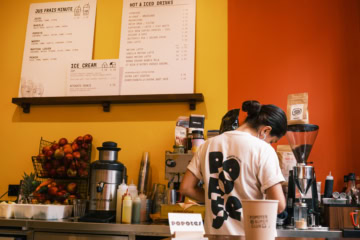

Popotes
Made-to-measure café-cantine
- Restaurant
- 11 locations
- Liquid capital: £70000

Costa Coffee
Mocha Italia, roasted and served since 1971
- Restaurant
- Liquid capital: £

Tim Hortons
Coffee, Timbits and an all-day menu
- Coffee
- Liquid capital: £
Cafe2U
A mobile café on a fixed weekly round
- Coffee
- Liquid capital: £15000

Esquires Coffee
Organic, Fairtrade coffee with an independent feel
- Coffee
- Liquid capital: £100000
6. Arrange the funding
Funding usually combines own capital with a commercial loan, and sometimes asset finance on the machine or the vehicle. Start Up Loans, run by a British Business Bank subsidiary, lends up to £25,000 per applicant at a fixed 7.5% over one to five years, unsecured, to a maximum of £100,000 per business. The British Business Bank’s guidance indicates that with an established franchise brand the franchisee will need at least 30% of total set-up costs, including working capital, from their own funds.
7. Find a site and negotiate the lease
UK commercial leases carry no statutory term structure and no automatic renewal right, so the term, the reviews and the exit are all negotiated. Most small hospitality units are let on a fully repairing and insuring basis, putting the repairing obligation on the tenant and creating a dilapidations liability at expiry. Personal guarantees are routine.
The clauses that decide the value:
- Security of tenure : in England and Wales the Landlord and Tenant Act 1954 Part II confers a renewal right, and contracting out requires the prescribed notice and declaration procedure. Scotland has no Part II equivalent, and Northern Ireland does not permit contracting out
- Rent review : upward-only reviews are common
- Break clause and alienation : the exit route, and whether the lease can be assigned
- VAT on rent : normally exempt, but a landlord that has opted to tax charges VAT at 20% on it
8. Register the food business and obtain the licences
Food business registration goes to the local authority at least 28 days before trading. It is free, it cannot be refused, and it applies to fixed premises, mobile units and stalls. Registration is not permission, and it is separate from planning: in England a coffee shop with seating falls within Use Class E, so a move between uses inside that class is not a material change, while a hot food takeaway sits outside it.
Requirements commonly include:
- Planning permission or a change of use : depending on the unit’s current Use Class and any alterations to the shopfront
- A pavement licence : for removable tables and chairs on the highway in England, under the Business and Planning Act 2020 as amended by the Levelling Up and Regeneration Act 2023. The fee is capped at £500 for a first application and £350 on renewal
- A premises licence, and a personal licence for the named holder : where alcohol is sold
- A documented food safety management system : with allergen information for prepacked for direct sale and loose items, ahead of the environmental health inspection that sets the published food hygiene rating
- Employers’ liability insurance and public liability cover : the first is a legal requirement once staff are taken on
9. Fit out the shop and source the equipment
The fit-out is normally the largest single line in a fixed-site budget, driven less by furniture than by services: extraction, water treatment, power, refrigeration and drainage. Most units are let in shell condition or as the previous tenant left them, so a former café and a former retail unit are very different propositions.
10. Recruit, train and open
The morning peak sets headcount. Staff need food hygiene training proportionate to their role, and right to work checks apply to every recruit. Training usually covers espresso and milk standards, allergens, the till’s eat-in and takeaway keys, and opening and closing routines. Since 1 October 2021, anything packed on site before a customer chooses it, such as a wrapped sandwich or a bagged cookie, carries a full ingredients label with allergens emphasised. On pay, the statutory floor is the National Living Wage, while the voluntary real Living Wage set by the Living Wage Foundation is £13.45 an hour, or £14.80 in London, for 2025-26, and many independents recruit against it.
Marketing starts before the fit-out ends: securing the coffee shop’s name on social platforms, setting up a Google Business Profile with accurate hours, showing the fit-out as it happens, and a soft opening for neighbours and nearby offices so the first reviews arrive before the first busy week.
What licences does a coffee shop need in the UK?
Registration is the only step every coffee shop takes; the rest depends on the site, the hours and the offer. In England and Wales:
| Licence or registration | When it is needed |
|---|---|
| Food business registration | Always, with the local authority, at least 28 days before trading. Free |
| Planning or change of use | When the unit is not already in a use that covers a café, or the shopfront changes |
| Pavement licence | For tables and chairs on the highway in England. Fee capped at £500, £350 on renewal |
| Premises licence for alcohol | When alcohol is sold, plus a personal licence for the designated premises supervisor |
| Premises licence for late night refreshment | When hot drinks or hot food are served between 11pm and 5am, including from a van |
| TheMusicLicence from PPL PRS | When any music is played, including a radio in the kitchen for staff |
| Street trading consent | For a van, cart or stall trading in a consent street, from each council traded in |
| Advertisement consent | For some shop signs, typically illuminated or projecting ones, and most signs in conservation areas |
| Employers’ liability insurance | A legal requirement from the first employee; public liability is not compulsory but landlords usually require it |
Sources: Licensing Act 2003; council licensing pages; PPL PRS. Scotland and Northern Ireland run separate licensing regimes.
Waste is a duty rather than a licence: in England, coffee grounds count as food waste and must be separated, since 31 March 2025 for businesses with 10 or more full-time equivalent employees and from 31 March 2027 for smaller ones.
Coffee shop equipment: what a new shop needs
- Espresso machine: sized to the morning peak, with group count following the queue, not the floor area
- Grinders: one per coffee on offer, plus one for decaf, since switching a grinder mid-service stops the queue
- Water filtration or softening: specified against the local water supply and usually a warranty condition
- Refrigeration: under-counter milk fridges at the machine, plus a display chiller if food is sold
- Dishwasher or glasswasher: and a separate wash-hand basin, since food hygiene rules require handwashing facilities apart from food preparation sinks
- Oven: for bake-off pastries or toasties, which changes the power load and the hygiene plan
- Till system: with separate eat-in and takeaway buttons so each sale carries the right VAT rate
- Supply route: bought outright, leased, or supplied by the roaster on a bean contract, which usually trades a lower upfront cost for a commitment to buy the roaster’s coffee
- In-house roasting: usually a later step. Gas roasters need extraction and often an afterburner; compact electric roasters reduce the ventilation work but still need power capacity, space and a roasting skill the coffee shop has to build
What the trading day actually looks like
- A large share of the day happens in about ninety minutes. Speed of service at eight in the morning is the whole operation, and everything else is a rounding error
- Afternoons are the problem to solve, not the morning. Most shops are busy at eight and empty at three, and what fills that gap decides the week
- Food carries the margin coffee alone will not. A pastry cabinet changes the basket; a kitchen changes the business
- Retail beans and equipment are high margin and take no extra labour, and they are zero-rated
- Barista turnover is high and training is the cost. Losing someone in week six means paying to train twice
- An owner behind the machine cannot grow the business, and cannot easily sell it either
Types of coffee shop business
Five formats account for most of the UK market, and they differ on who controls the site.
- Mobile van or trailer : serves business parks, industrial estates and events. No premises, no lease and no business rates on a shop, with the vehicle as the main asset
- Kiosk or counter concession : inside a transport hub, supermarket or hospital. Lower fit-out, but the host controls the site and it is usually won by tender
- High street eat-in shop : the classic format, with the highest exposure to rent, rates and dilapidations, and goodwill attached to the site
- Drive-thru : roadside and retail park sites, high volume, and the most capital-intensive, since it usually involves land, construction and planning consent
- Roastery-café or food-led hybrid : adds wholesale, e-commerce or a bakery offer
How much does it cost to open a coffee shop?
There is no official UK average start-up cost for a coffee shop, and no disclosure filing to consult, because the UK has none. What is citable is what named franchisors publish about their own models, which at least shows the spread between formats.
The lines that move a start-up budget most are:
- The site and the lease : any premium, the rent deposit, and on an FRI lease the repairing obligation and dilapidations at expiry
- The fit-out, the equipment and the opening stock : extraction, water treatment, power, refrigeration, counter and seating, plus the machine, the grinders and the opening coffee order
- Business rates : rateable value multiplied by the applicable multiplier, net of any relief
- Staff : the National Living Wage is £12.71 an hour for those aged 21 and over from 1 April 2026 and £10.85 for 18 to 20 year olds, plus employer National Insurance at 15% above £5,000 a year per employee, less the £10,500 Employment Allowance, and a 3% employer pension minimum on qualifying earnings
- Licences and professional fees : registration is free and a pavement licence is capped at £500 in England, solicitors’ fees are not
- Working capital : the months between opening and settled trade, and the line the British Business Bank’s 30% indication explicitly includes
Good to know
Business rates are the line most often left out of a coffee shop budget, and they changed in England on 1 April 2026. Five multipliers now apply, including a small business retail, hospitality and leisure multiplier of 38.2p under £51,000 rateable value and a standard RHL multiplier of 43.0p up to £499,999, replacing the temporary 40% RHL discount. Small Business Rate Relief still gives 100% relief up to £12,000, tapering to nil at £15,000. England only: Scotland, Wales and Northern Ireland run separate schemes.
Opening a café on a low budget or with no money
There is no zero-capital route into coffee, but the low-budget routes share one feature: they avoid the fit-out. Operators commonly start with a van, cart or market stall; a counter or concession inside a host site such as an office, gym or garden centre; the assignment of an existing café lease with the kit already in place; or a pop-up on short-term licence. An online bean brand can start from home, registered as a food business, with the council consulted if the home is used for trade. A roaster-supplied machine removes the largest equipment cost, and Start Up Loans funds up to £25,000 unsecured. Food registration is free and cannot be refused.
What changes when opening a coffee shop in London
Rent is the obvious difference. Business rates differ too: London valuations rose by an average of 22.3% at the 2026 revaluation, transitional relief caps 2026/27 increases at 5% for London properties up to £28,000 rateable value against £20,000 elsewhere, and the Crossrail Business Rate Supplement of 2p in the pound applies only above £92,000 rateable value, so most small cafés fall below it. The National Living Wage is the same as everywhere else; the London Living Wage is voluntary. Pavement licences and street trading are handled borough by borough.
Coffee shop franchise opportunities in the UK
Franchising in the UK is governed by general contract law. There is no franchise statute, no register and no statutory pre-contract disclosure requirement, and the British Franchise Association’s Code of Ethics binds its voluntary members rather than the market. Per-brand figures therefore come from what each franchisor publishes on its own pages, dated, and nothing else.
In coffee, as in much of UK franchising, several of the largest brands recruit operators who already hold the site or the operating business. “It is a franchise” and “an individual can buy one” are two separate statements.
Editor’s tip
What separates the mobile model from the high street model is not the coffee, it is the property. A van carries no rent, no service charge, no business rates on a shop and no dilapidations, and its goodwill travels with the round. A fixed shop attaches its goodwill to a site, which is why the renewal position on the lease decides what the business is worth on a resale.
How to market a coffee shop locally
Coffee is a repeat trade, so marketing is about frequency rather than reach. A Google Business Profile, accurate opening hours and photographs that look like the actual shop do more than paid advertising, because most people searching for coffee are within walking distance and deciding in the moment. Reviews arrive early and persist, which is the argument for that soft launch.
Beyond that the things that work are unglamorous: a loyalty scheme rewarding the fifth visit rather than the fiftieth, a relationship with nearby offices, and being the shop that opens reliably at seven when the one opposite opens at eight. Wholesale bags and office accounts are worth the effort for the same reason, because they generate revenue that does not depend on someone walking through the door.
The practical difficulties operators report
Four pressures dominate trade coverage in 2026, and none is about the coffee.
- Labour cost : the 18 to 20 band rose 8.5% to £10.85 an hour on 1 April 2026, the steepest of the four bands and the one matching the age profile food service tends to employ. There is no tipped wage in the UK: the minimum must be met in pay before tips
- Occupancy cost reset : the 2026 revaluation gave every property in England a new rateable value from 1 April 2026, based on rents at 1 April 2024, at the same time as the multipliers changed. A lower multiplier does not automatically mean a lower bill
- Green coffee volatility : Arabica futures reached a record in February 2025 and have traded well above their pre-2024 range since, in a market priced in US dollars. Suppliers report that energy, labour and packaging costs have not come down with it
- Density of competition : more than 12,300 branded outlets on top of the independents, in a category that now takes in bakery chains and forecourt sites
The bottom line
- Check water hardness, power capacity and drainage before signing anything
- Set the till categories correctly on day one: eat-in is 20%, cold takeaway is 0%, hot drinks are 20% either way
- Choose the roaster and the service agreement before the machine
- Ninety minutes in the morning carries the day, and the afternoon is the problem to solve
- Separate food waste from 31 March 2025 at 10 or more staff, 31 March 2027 below that
- The alienation clause decides whether the business can ever be sold
Opening a coffee shop in the UK runs through the same sequence whatever the format: format and catchment, plan and funding, site and lease, registration and licences, fit-out, then staff and opening. On the franchisors’ own published figures the capital spans from around £42,500 for a franchised van to £250,000 or more for a high street shop, with no official UK average in between. Property, labour and the coffee price are the variables that move.
Frequently asked questions about opening a coffee shop in the UK
No official UK average exists and there is no disclosure filing to consult. The citable figures are franchisor-published: Cafe2U gives around £42,500 for a mobile van including a vehicle deposit and equipment, and Esquires Coffee gives £250,000 to £300,000 for a high street shop, excluding stock, marketing and working capital.
Food business registration with the local authority is required at least 28 days before trading, and it is free and cannot be refused. Beyond that it depends on the site: planning permission or a change of use, a pavement licence for tables on the highway, and a premises licence where alcohol is sold. Procedures differ between England, Scotland, Wales and Northern Ireland.
Yes, at 20%. Hot drinks including tea, coffee and hot chocolate are standard-rated whether drunk on the premises or taken away. Anything consumed on the premises is a supply in the course of catering and is standard-rated regardless of what it is, so a cold sandwich eaten at a table is 20% while the same sandwich in a bag is zero-rated. Retail coffee beans sold to take home are zero-rated. This is why cafés record eat-in and takeaway separately at the till.
In England, yes, and the deadline depends on size. Under Simpler Recycling, businesses and non-domestic premises with 10 or more full-time equivalent employees have had to separate food waste, dry recyclables and residual waste since 31 March 2025. Businesses below that threshold have until 31 March 2027, when flexible plastics are added for everyone. Coffee grounds and tea bags count as food waste and must be separated, whatever the quantity. Wales operates equivalent workplace recycling rules.
Three recur. Signing a lease before checking water hardness, power capacity and drainage, any of which can make a unit unworkable or expensive. Designing the counter for looks rather than for the morning queue, when order sequencing is what limits throughput at peak. And planning for the morning while ignoring the afternoon, which is where most shops are empty and where the week is actually won or lost.