
Nail salons were among the businesses leading the growth in UK hair and beauty premises in the first half of 2025, according to the National Hair & Beauty Federation. Two changes in 2026 reshape how one opens: gel products containing TPO can no longer be newly sold in Great Britain, and right to work checks now reach self-employed technicians in a sector the Home Office names among its enforcement targets.
No national licence is needed to open a nail salon in most of the UK, but London boroughs and some Scottish councils license nail treatments, and chemical safety law applies everywhere. Tax and immigration rules below are UK-wide. Much of the chair rental framework is shared with hairdressing and set out in how to open a hair salon in the UK.
What is a nail salon business?
A nail salon business provides manicures, pedicures, gel and BIAB overlays, acrylic and gel extensions and nail art from premises, with technicians who are either employed or self-employed and renting a desk. It differs from a hair salon in three ways that shape the business: services are longer, so each desk sells fewer appointments a day; the products are chemicals whose vapour and dust fall under health and safety law; and the ingredients themselves are regulated by cosmetics law, as the 2026 TPO ban shows.
How to open a nail salon in the UK, step by step
The checklist, in the order openings usually run:
- Services and staffing model chosen: employed technicians, desk renters or both
- Right to work position checked under the October 2026 rules
- Each desk costed on services per day
- Product range checked for TPO and other restricted ingredients
- Ventilation and dust control planned before the fit-out
- Licensing checked: London, Scotland and any add-on services
- Site found, with business rates and concession options checked
- Technicians recruited, with pay, tips and qualifications in place
- Hygiene routine written for files, tools and dust
- Bookings, deposits and card payments set up
| Stage | What typically happens |
|---|---|
| Weeks 1 to 4 | Services and model chosen, desks costed, site search, licensing position checked with the council |
| Weeks 5 to 8 | Lease agreed, extraction quoted, product range sourced TPO-free, agreements drafted |
| Weeks 9 to 12 | Fit-out with ventilated desks, licence inspection where required, technicians recruited and checked |
| Months 4 to 12 | Regular clients built on infill and maintenance cycles, desk occupancy reviewed, prices adjusted |
Illustrative sequence, L’Express Franchise, October 2026. A London special treatment licence can add weeks before opening.
1. Choose the services and the staffing model
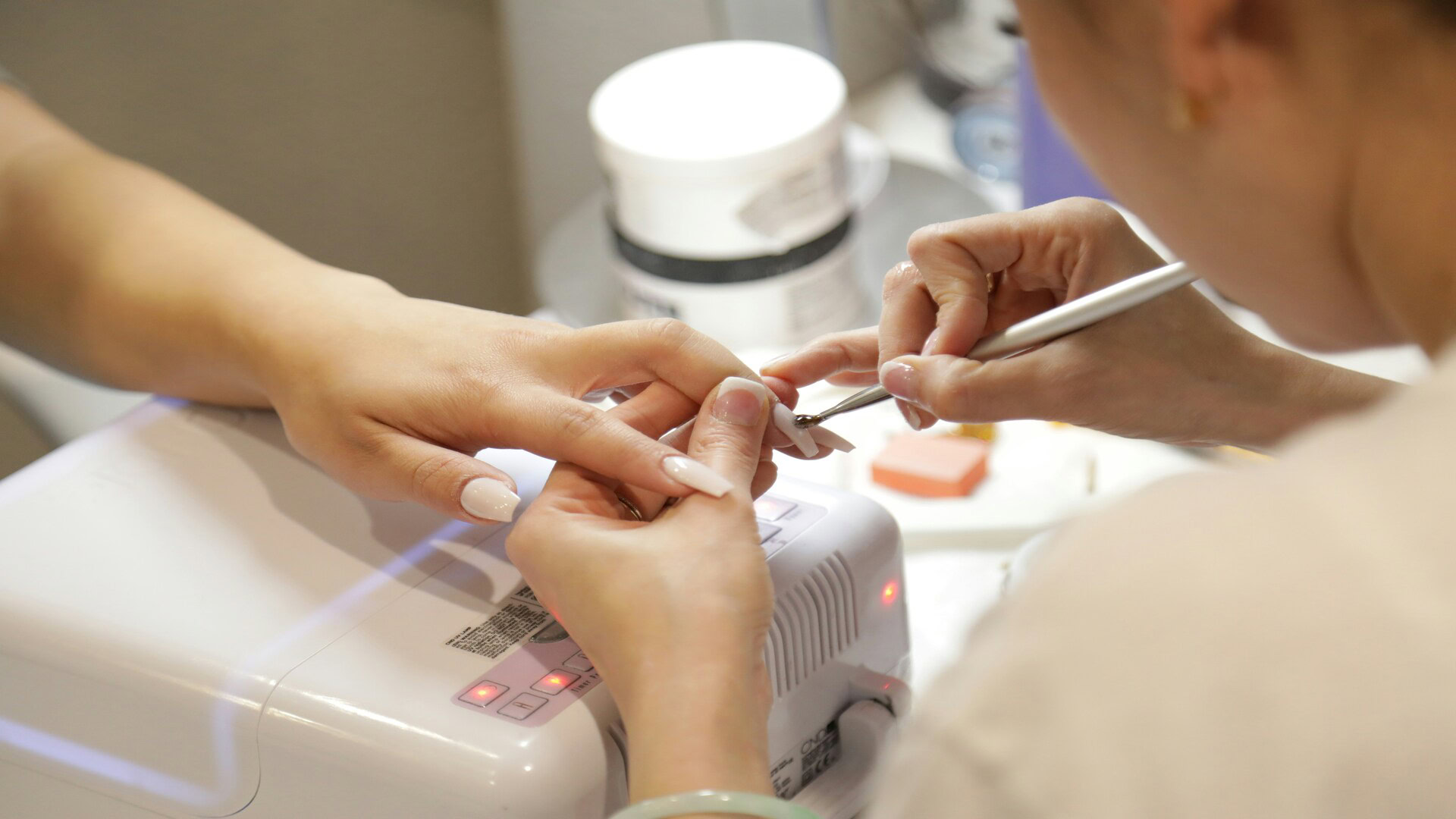
A nail salon is staffed in one of three ways: employed technicians on wages, self-employed technicians renting a desk and serving their own clients, or both. HMRC’s guidance for hair and beauty, published on 9 May 2025, judges status from working practice, not the contract: who sets hours and prices, who provides the clients, who the client pays and who supervises. Adverts on the government’s Find a Job service show both models in use: salons offering a nail bar for rent to a self-employed technician offering gel polish, BIAB and extensions, and salons employing technicians at £8.60 to £13 an hour depending on experience in 2025, often starting on two or three days a week and building up.
Owners who have opened a nail salon describe the same route in: years in busy salons first, then a studio built around a niche, from detailed nail art to clients who find conventional salons overwhelming. Ownership also means juggling staff, stock, HMRC, the landlord, insurance and a broken pipe on the same day, so the first test of the plan is whether the business can run when the owner is away.
2. Check the right to work position
Nail bars are one of the sectors the Home Office names when it reports illegal working enforcement. Its figures, released on 13 January 2026, recorded a record 12,791 visits in 2025 to businesses including nail bars, car washes, barbers and takeaways, and figures published in December 2024 showed its Operation Tornado had made 235 visits to nail bars and convenience stores, with 154 arrests. The Gangmasters and Labour Abuse Authority has also published modern slavery cases involving nail bars.
From 1 October 2026, the right to work scheme covers workers and individual subcontractors as well as employees, so technicians paid by the salon to serve its clients, whatever their contract says, are likely in scope, while genuinely self-employed desk renters serving their own clients fall outside it. A London nail group advertising self-employed roles in 2026 already required proof of UK citizenship or a valid work permit.
Good to know
The civil penalty for illegal working is up to £45,000 per worker for a first breach and £60,000 for a repeat breach within three years. A compliant check carried out before work starts gives the business a statutory excuse. For workers and individual subcontractors, penalties apply where the engagement began on or after 1 October 2026, so the check belongs in the onboarding of every technician who starts from now on.
3. Cost each desk on services per day
In a nail salon, services take longer than a haircut, which changes the economics. The worked example uses an eight-hour day, one-hour slots including preparation and cleaning, a £30 average service and a desk rent of £80 a week, the figure a Braintree nail and brow bar advertised for a self-employed technician on the trade forum SalonGeek:
| One desk, one day | Employed, half booked | Employed, three-quarters booked | Desk rented at £80 a week |
|---|---|---|---|
| Services sold, from 8 slots | 4 | 6 | Technician’s own clients |
| Takings to the salon | £120 | £180 | £16 of rent |
| Wage at £13.00 an hour for 8 hours | £104 | £104 | None |
| Products at about £3 a service | £12 | £18 | None |
| Left before salon rent and overheads | £4 | £58 | £16 |
Illustrative service inputs, L’Express Franchise, October 2026. Wage before employer NI and pension. Desk rent: Braintree advert, £80 a week over five days.
An employed nail desk barely covers its wage at half its slots, which is why so many nail businesses run on desk rental or pay technicians partly on commission. Pricing by the minute shows where the margin is: a £30 gel or BIAB service taking 45 minutes earns £40 an hour of desk time, while a £40 acrylic full set taking 90 minutes earns £26.67. Real salons’ published prices show what a nail salon earns per hour of desk time:
4. Check every product for TPO
TPO, listed on labels as trimethylbenzoyl diphenylphosphine oxide, is a photoinitiator that helps many gel and builder products cure under UV or LED lamps. It was classified as a reproductive toxicant, and Great Britain has restricted it under SI 2026/23 in two stages:
| Date | What changes in Great Britain |
|---|---|
| 15 August 2026 | Products containing TPO can no longer be placed on the market for the first time |
| 14 February 2027 | Products containing TPO can no longer be made available, so distributors stop supplying them |
| Northern Ireland | The EU ban has applied since 1 September 2025, with no sell-through period |
Sources: SI 2026/23, made 12 January 2026, extending to England, Wales and Scotland; CTPA guidance as reported by Scratch; British Beauty Council.
Gel manicures themselves are not banned, and TPO-free formulations using other photoinitiators are on sale. The Cosmetic, Toiletry and Perfumery Association’s guidance is that professionals in Great Britain can continue to use products they have already bought; some consumer sources state the opposite for salons after February 2027, so a new nail salon avoids the question by stocking TPO-free products from the start and checking every label.
5. Plan ventilation and dust control before the fit-out
In a nail salon, acrylic liquids, gels and filing dust fall under the Control of Substances Hazardous to Health Regulations. Council guidance for nail salons, from Braintree and Dudley among others, describes local exhaust ventilation as necessary for methacrylate products and the ventilated nail desk, which draws vapour and dust down and away from the technician’s breathing zone, as the most suitable form.
HSE-funded research, published as report RR627, found nail technicians reported more work-related nasal and respiratory symptoms than a comparison group, and that over a quarter did not know whether their products contained EMA or MMA.
- Extraction: ventilated desks or extraction at each station, ducted outside where possible, with filters changed on the maker’s schedule
- MMA: methyl methacrylate liquid monomer is the acrylic ingredient councils warn against most; Dundee City Council’s nail bar licence forbids MMA products outright
- E-files: Dundee’s conditions also restrict electric files to the surface of the artificial nail, never the natural nail
- Lids and dispensers: solvents and liquids kept in closed containers between uses to cut vapour
- Protection: gloves, eye protection when removing enhancements, and hand washing through the day
In a nail salon, the desks themselves are not the expensive part. UK salon suppliers list nail stations with a built-in dust extractor from £129.99 excluding VAT on offer at Salon Serve, against £219 at full price, and £450 excluding VAT for a Hara Canto station at Aston & Fincher. Those units capture filing dust at the desk; vapour from liquids and gels is what pushes a salon towards ducted extraction, and that cost depends on the building, which is why it belongs in the quote before the lease is signed.
6. Check what licensing applies where
Across most of England there is no licence needed to open a nail salon, and guides that present a council licence as the key legal requirement for every nail salon describe the London position, not the national one. Where licensing does apply, it is serious:
- London: manicure, pedicure and nail extensions are special treatments under the London Local Authorities Act 1991, licensed by each borough and renewed yearly; Tower Hamlets charges £700, and Barking and Dagenham warns of fines up to £5,000 for trading without one
- Scotland: some councils license nail bars; Dundee City Council attaches conditions on products, dust, odour and electric files
- Add-on services elsewhere: microblading and other semi-permanent brow work count as semi-permanent skin colouring, and ear piercing as skin piercing, both needing council registration of the practitioner and the premises; Stafford charges £101.45 per premises and £61.30 per person for ear piercing
- Aesthetics: the national licensing scheme for non-surgical cosmetic procedures in England, enabled by the Health and Care Act 2022, still had no regulations in 2026; it targets treatments such as injectables, lasers and peels, so a nail salon adding them would be caught once it starts
7. Find the site and check concession options
From 1 April 2026, hair and beauty premises in England qualify for the lower retail, hospitality and leisure business rates multipliers, 38.2p below £51,000 rateable value and 43.0p above it, and Small Business Rate Relief removes the bill at a rateable value of £12,000 or less. Nail businesses use concessions more than most: nail salons operate inside gyms such as Total Fitness, Dublin Nails runs studios inside Penneys stores and the Brown Thomas and Arnotts department stores, and Selfridges Birmingham hosts a nail bar run by an established brand. A nail salon in a concession trades on the host’s footfall, on the host’s hours and terms. For a nail salon in a standalone unit, the lease has to allow extraction ducting to be installed and routed outside.
8. Recruit, train and set the pay rules
No qualification is legally required to work as a nail technician or to own a nail salon; the voluntary register under the Hairdressers (Registration) Act 1964 covers hairdressing, not nails. Qualifications matter in practice: salon adverts for desk renters commonly ask for a qualification and insurance, and insurers set their own conditions. Pay rules apply in full to employed technicians:
- Pay: the National Living Wage is £12.71 an hour at 21 and over from 1 April 2026, £10.85 at 18 to 20 and £8.00 for apprentices under 19 or in their first year
- Tips: since 1 October 2024, all tips paid through the business pass to staff without deductions, and tips never count towards the minimum wage; desk renters keep their own
- Apprentices: for employers that do not pay the apprenticeship levy, a £2,000 hiring payment applies to apprentices aged 16 to 24 starting from 1 October 2026, on top of £1,000 for those aged 16 to 18
- Employer costs: employer National Insurance at 15% above £5,000 a year, offset by the £10,500 Employment Allowance
9. Write the hygiene routine
A written hygiene routine is what an inspector, an insurer and a London licensing officer ask a nail salon to show. Council guidance for nail salons covers the same points: tools cleaned and disinfected between clients, single-use items such as files and buffers used once or kept for one client, work surfaces wiped down, waste and dust bagged, and a client record noting any skin or nail conditions before treatment. Dundee’s licence conditions require a signed client record for each treatment.
10. Set up bookings, deposits and payments
- Booking cycles: gel, BIAB and extensions bring clients back for maintenance, so rebooking at the end of each appointment fills a nail salon’s diary weeks ahead
- Deposits: a deposit on long appointments protects the most valuable slots from no-shows; a common published policy refunds the deposit only when a client cancels at least 48 hours before the appointment
- Prices: pricing lower because a salon is small or home-based undercuts the business; a clear niche attracts clients who pay for it
- Experience over looks: clients judge the whole journey, from booking to aftercare, more than how Instagrammable the salon looks
- Booking marketplaces: Fresha’s fee for a new client found through its marketplace is reported at 20% of the first booking with a UK minimum of £4 plus VAT, worth paying only for clients who return
- Card payments: SumUp publishes 1.69% for in-person card payments and Square 1.75%, and card records support the accounts and any later sale of the business
Types of nail salon
| Model | How it works |
|---|---|
| Walk-in nail bar | High street, high volume, shorter services, often employed or commission-paid staff |
| Appointment studio | Booked services, longer treatments such as extensions and nail art, higher prices |
| Desk in a hair or beauty salon | A self-employed technician rents a desk, as in adverts from Bristol and Southport salons |
| Concession | Inside a gym, department store or fashion retailer, on the host’s hours and terms |
| Home or mobile studio | Alice Morrey moved One Nail To Rule Them All in Huddersfield from a kitchen table to a spare-bedroom salon in 2021; business rates can apply where clients visit, and Scratch Stars finalists advise telling neighbours before opening |
| Salon with an academy | Caroline Dean runs two salons and a training academy at North in Hartlepool, where acrylic extensions and builder gel are the most popular services |
| Franchise or licensed brand | A nail brand’s format, training and systems, against fees set in the agreement |
L’Express Franchise, October 2026.
How much does it cost to open a nail salon?
No official UK average start-up cost exists for a nail salon. What can be stated is what licensing and statutory lines cost, what real openings reported and how the monthly numbers work:
| Cost line | Published figure |
|---|---|
| London special treatment licence | Set by each borough and renewed yearly, for example £700 in Tower Hamlets |
| Business rates, England | Rateable value × 38.2p below £51,000; Small Business Rate Relief removes the bill at £12,000 or less |
| Skin piercing registration, for add-ons | Set locally, for example £101.45 per premises and £61.30 per person in Stafford |
| Staff | £12.71 an hour at 21 and over; employer NI 15% above £5,000, less the £10,500 Employment Allowance |
| Card payments | 1.69% with SumUp, 1.75% with Square, in person |
Sources: council pages; GOV.UK; HMRC; SumUp UK pages.
The lines that move a start-up budget most are:
- The lease, including any premium and the rent deposit
- Extraction: ventilated desks or ducted systems, often the largest single fit-out item
- Desks, chairs, pedicure stations and lighting
- Opening stock of TPO-free gels, acrylics, polishes and consumables
- Booking and payment systems, insurance and professional fees
- Working capital for the weeks before regular clients rebook
A month in a four-desk studio
The worked example takes an owner working one desk and three desk renters at £80 a week each, with illustrative overheads for a small unit qualifying for full Small Business Rate Relief:
| Monthly line | Figure |
|---|---|
| Rent | £1,400 |
| Utilities, insurance, extraction servicing, booking software and card fees | £450 |
| Products, consumables and marketing | £300 |
| Overheads | £2,150 |
| Desk rent from three renters at £80 a week | minus £1,040 |
| Left for the owner’s desk to cover | £1,110, or 37 services at £30 |
| Owner’s takings at 60% of slots over 22 days | £3,168 |
| Owner’s income before tax | £2,058 |
Illustrative inputs, L’Express Franchise, October 2026. £80 x 52 / 12 x 3 = £1,040; 22 days x 8 slots x 60% = 106 services x £30 = £3,168.
On these figures the studio stays below the £90,000 VAT threshold, at about £50,500 a year of owner takings and desk rent combined. Desk rent from a VAT-registered salon is standard-rated: HMRC’s VAT manual treats salon chair rental as a taxable supply because shared facilities such as reception and waiting areas are part of what is supplied.
Opening a nail salon on a low budget
The lowest-cost routes into running a nail salon avoid a full fit-out: renting a desk in an existing hair or beauty salon to build a client list, working as a mobile technician, or taking a concession where the host provides the space. Start Up Loans lends up to £25,000 per applicant at a fixed 7.5%, unsecured, which covers much of the entry range for the low cost franchises in the UK.
Nail salon franchise opportunities in the UK
Several nail brands have sought franchisees in the UK, and none of those checked publishes an entry figure, which leaves the beauty and wellbeing franchises listing as the place to compare what others do publish:
- N.Bar, part of The Grooming Company, which also owns Trevor Sorbie, has presented itself at the International Franchise Show as a management franchise needing no previous nail experience, with 27 stores in six countries and owner training in Dubai; investment is given on request, and its Franchise Direct profile is no longer live
- Nails, the brand behind Dublin Nails, describes more than 16 studios including concessions in Penneys, Brown Thomas and Arnotts, and sends its prospectus on request
- Townhouse, a luxury nail salon brand founded in 2018, advertises franchise partnerships for the UK and abroad
Editor’s tip
Buying an existing nail salon now calls for three checks that were not needed a year ago. The right to work file has to cover every technician who started after 1 October 2026, employed or not. The stockroom has to be checked label by label for trimethylbenzoyl diphenylphosphine oxide before the February 2027 supply deadline. And the extraction has to be working and serviced, because ventilation is the first thing a London licensing officer or an environmental health inspector looks at.
The practical difficulties operators report
- Long services, thin employed margins: at one service an hour, an employed desk in a nail salon needs to be busy most of the day to cover its wage
- Enforcement attention: nail bars are named in Home Office illegal working figures, and the October 2026 rules widen who must be checked
- Product rules move: the TPO restriction shows a single ingredient change can force a salon to replace its gel range
- Dust and vapour: extraction is costly to install, and without it technicians report more respiratory symptoms, according to HSE-funded research
- Licensing depends on the postcode: a London borough licence, a Scottish council licence or nothing at all
- Competition is dense: one mid-sized English city already had 15 nail businesses when a new salon opened there in 2025
The bottom line
Opening a nail salon in the UK needs no national licence outside London and some Scottish councils, but it is more chemically regulated than most small businesses: TPO-containing gels left the Great Britain market from 15 August 2026, and ventilation sits under COSHH. The staffing model carries the right to work test as well as HMRC’s, since 1 October 2026. Commercially, long services make employed desks expensive: on illustrative figures, an employed desk leaves £4 a day at half its slots, against £16 a day from a desk rented at £80 a week, so occupancy and pricing by the minute decide which model pays.
Frequently asked questions about opening a nail salon in the UK
Not across most of England. London boroughs license manicure, pedicure and nail extensions as special treatments, renewed every year, and some Scottish councils such as Dundee license nail bars. Elsewhere, add-on services such as ear piercing or semi-permanent brows need council registration of the practitioner and the premises.
No qualification is legally required. The voluntary register under the Hairdressers (Registration) Act 1964 covers hairdressing, not nails. In practice, salons renting desks commonly ask for a qualification and insurance, and insurers set their own conditions.
No. Gel manicures are not banned. One ingredient, TPO, listed as trimethylbenzoyl diphenylphosphine oxide, is restricted in Great Britain: products containing it could not be newly placed on the market from 15 August 2026, and cannot be supplied by distributors from 14 February 2027. TPO-free gels are on sale.
The Cosmetic, Toiletry and Perfumery Association’s guidance is that professionals in Great Britain can continue to use products they have already bought, though some sources state otherwise for salons after February 2027. In Northern Ireland the EU ban has applied since 1 September 2025. Stocking TPO-free products avoids the question.
Yes. Acrylic liquids, gels and filing dust fall under the Control of Substances Hazardous to Health Regulations, and council guidance describes local exhaust ventilation as necessary for methacrylate products, with ventilated nail desks as the most suitable form.
There is no published average. Adverts posted by salons on the trade forum SalonGeek show nail desks at £50 a week in Maidstone and £80 a week in Braintree, where the salon asked for CND training and two years’ experience. What the rent includes, such as a pedicure station, utilities or a booking system, varies, and a VAT-registered salon adds VAT.
Since 1 October 2026 the right to work scheme covers workers and individual subcontractors as well as employees. Genuinely self-employed technicians renting a desk and serving their own clients fall outside it, but technicians paid by the salon to serve its clients are likely in scope, whatever their contract says.
No official UK average exists. A Gloucester salon that opened in January 2025 reported a £150,000 investment with ten jobs, while smaller studios open on personal savings. Extraction, desks, the lease and opening stock are the main costs, plus a yearly special treatment licence in London.
Where the salon is VAT-registered, desk rent is standard-rated in the same way as chair rent: HMRC’s VAT manual treats salon chair rental as a taxable supply because shared facilities such as reception and waiting areas are part of what is supplied.
Yes, as a self-employed technician, but business rates can apply on top of Council Tax where clients visit or the home has been altered for the business, as GOV.UK explains. In London, boroughs license premises offering nail treatments, so whether a home studio needs a special treatment licence is a question for the borough.