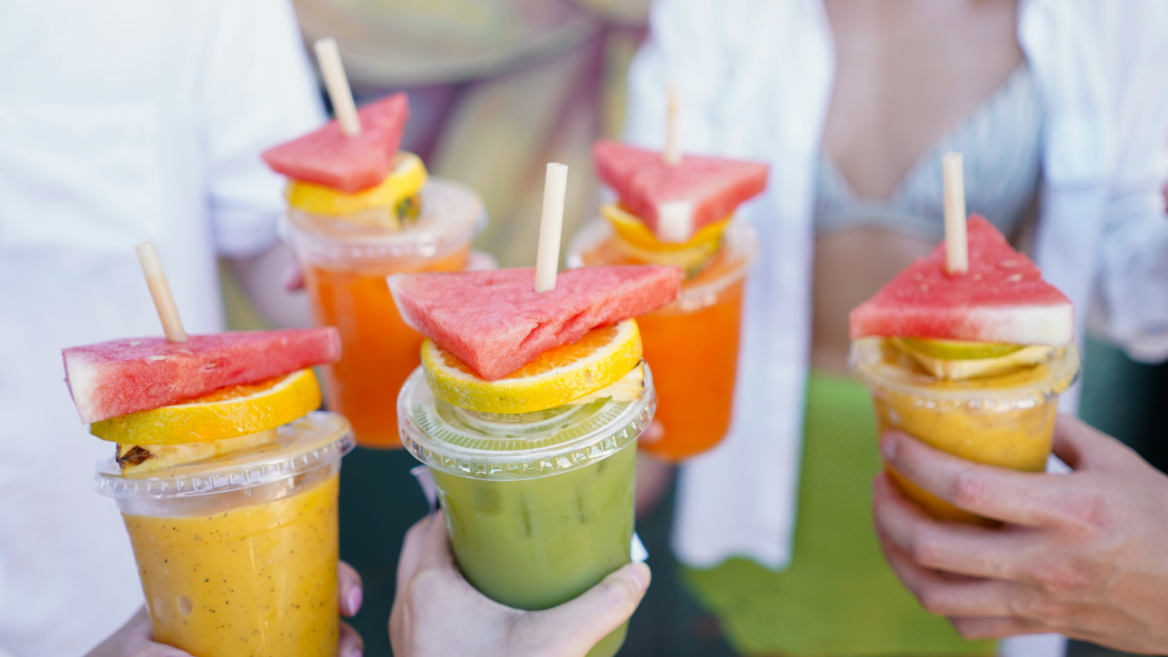

The juice bar industry has grown 5.3% annually over the past five years, reaching roughly 5,700 establishments. With average profit margins near 5% and rising demand for functional beverages, this guide explores the costs, licenses, operational steps, and franchise opportunities for starting a juice bar and smoothie business in the U.S.
The category has evolved into a mainstream quick-service segment, spanning mobile trucks, brick-and-mortar bars, and bottled juice brands. In 2025, the number of establishments grew 3.3%, with an average of 11 employees per business.
Can Anyone Open a Juice Bar?
The juice bar sector has relatively low regulatory entry barriers, but food-service compliance is stricter than for non-food service businesses. There is no federal license to operate a juice bar, though state and local health departments play the largest regulatory role.
Common requirements typically include:
- A local business license or permit from the city or county clerk.
- State business registration (LLC, S-Corp, or DBA).
- Food Facility Health Permit issued by the local or state health department.
- Food handler certification for all staff who prepare or serve juice.
- ServSafe or equivalent manager-level food safety certification for the owner or general manager, in most states.
- FDA Juice HACCP compliance if the business sells packaged juice to other businesses (wholesale), or ships juice across state lines.
- Certificate of occupancy and building/zoning approval for the physical location.
Starting a juice business from home is possible under some state cottage food laws, but most states prohibit selling low-acid or raw juice through cottage food channels. Operators pursuing a home-based model typically use a licensed commercial kitchen or a shared culinary incubator to satisfy state health requirements.
How to Open a Juice Bar and Smoothie Business in the U.S.
Step 1. Choose Your Juice Business Model
Juice concepts vary widely in cost, format, and target audience. Common models include a brick-and-mortar juice bar, a juice truck or mobile cart, a cold-pressed juice production and delivery business, a home-based juice business through commissary kitchens, and a franchise unit. Each model has different licensing, equipment, and staffing implications.
Step 2. Research Your Local Market
Local market analysis typically covers foot traffic, competing juice bars and smoothie shops in a 1 to 3 mile radius, average local price points, and demographics. Census Bureau and BLS data provide free demographic and income information by zip code. Operators often study nearby gyms, yoga studios, and health food stores as leading indicators of demand.
Step 3. Create a Business Plan
A business plan for starting a juice bar typically documents the concept, menu, pricing, location strategy, financial projections, staffing, and marketing approach. Lenders and franchisors generally require one before approving funding or accepting franchisees. Free business plan templates are published by the SBA and by SCORE, an SBA-partner nonprofit.
Step 4. Research State Licensing Requirements and Secure Permits
This step is the most administratively important for any food-service business. Requirements vary significantly by state and municipality. Common documents include:
- Local business license: city or county clerk ($50 to $400 typical).
- State business registration: Secretary of State ($50 to $500).
- Federal EIN: free from IRS.gov.
- Food Facility Health Permit: local or state health department ($100 to $1,000 annually, varies widely).
- Food handler cards: required for staff in most states.
- Manager food safety certification: ServSafe or equivalent.
- Certificate of occupancy and building code inspection.
- FDA Juice HACCP plan: required if selling wholesale, shipping interstate, or operating a cold-pressed juice production facility.
- Grease trap or plumbing permits: often required for juice production sinks.
- Signage permit: required by many municipalities.
Cold-pressed juice operations that produce refrigerated packaged juice for retail typically require a licensed commercial kitchen, a written HACCP plan, Process Authority review of the recipes, and specific labeling per FDA rules.
Step 5. Find a Location or Home-Based Setup
Juice bar locations typically range from 600 to 1,500 square feet, though smaller kiosks and food-hall stalls also succeed with less space. High foot-traffic areas near gyms, offices, universities, and shopping centers are commonly cited as the strongest categories.
For a home-based juice delivery business, operators typically rent time in a licensed commercial kitchen (commissary) because most states prohibit selling raw or low-acid juice from a residential kitchen under cottage food laws. Juice truck operators need a commissary contract and a mobile food unit permit in most jurisdictions.
Step 6. Procure Supplies and Equipment
Equipment needs vary by concept. A traditional juice bar typically requires a commercial cold-press juicer or centrifugal juicer (or both), a commercial blender line, a walk-in cooler, refrigerated display cases, a POS system, sinks meeting local health codes, and packaging materials. Cold-pressed juice production adds hydraulic press systems, HPP (High Pressure Processing) machines or contracts with an HPP facility for shelf-life extension, and bottling equipment.
Ongoing supply costs are dominated by fresh produce, which represents a major share of cost of goods sold. Reliable produce sourcing agreements with local farms, wholesalers, or specialty distributors are standard practice.
Step 7. Set Your Prices
Juice bar pricing generally reflects ingredient costs and local market benchmarks. National industry surveys commonly cite retail prices of $6 to $10 per 12 oz to 16 oz juice or smoothie, with cold-pressed bottled juices reaching $8 to $14 per 16 oz bottle. Cleanse programs and multi-day juice packages typically retail from $150 to $300 per three-day program.
Step 8. Launch Marketing
Juice bar marketing typically combines digital and neighborhood channels. Common tactics include a Google Business Profile listing, a simple ordering website or DoorDash and Uber Eats integration, active profiles on Instagram and TikTok showcasing juice preparation, partnerships with local gyms and yoga studios, sampling events, and loyalty programs to drive repeat visits. Cleanse and subscription programs (weekly or monthly delivery) are widely used to generate recurring revenue.
Good to know
FDA Juice HACCP compliance is the item that most often trips up new juice operators. It applies to any business that packages juice for wholesale distribution or ships juice across state lines. It does not apply to juice sold directly to the customer in the same establishment where it is made. Operators launching a cold-pressed brand for retail bottles typically also need a Process Authority review of each recipe before production.
Is It Also Possible to Open a Juice Bar and Smoothie Business as a Franchise?
Yes, the U.S. juice and smoothie bar sector supports several established franchise systems. Franchising offers brand recognition, an operating playbook, supply chain agreements, and marketing support in exchange for an initial fee and ongoing royalties. Established juice bar franchises include:

Jamba
Smoothies, Juices and Bowls
- Restaurant
- Liquid capital: $120000


Nékter
Get Fresh With Nékter
- Restaurant
- Liquid capital: $100000
Juice It Up!
Live Life Juiced!
- Restaurant
- Liquid capital: $150000
Robeks
Make Happiness the Flavor of Your Community
- Restaurant
- Liquid capital: $149000

Tropical Smoothie Cafe
It’s Tropic Time
- Restaurant
- Liquid capital: $500000
Prospective franchisees typically review each system’s FDD, examining Item 5 (initial fee), Item 6 (royalty), Item 7 (estimated initial investment), and Item 19 (financial performance representations, when disclosed). State franchise registration portals (California DFPI, Wisconsin DFI, Minnesota Commerce) provide access to current FDD filings.
How Much Will It Cost to Open a Juice Bar and Smoothie Business in the U.S. in 2026?
What do I need to start a juice business depends primarily on the format. There is no federally published aggregate startup cost figure for juice bars, so the table below itemizes the actual line items a single operator typically faces. Each row indicates whether the value comes from a federal or state source, or reflects an industry-typical range without a published national statistic.
| Cost Item | Juice truck / mobile | Brick-and-mortar juice bar | Source / Note |
|---|---|---|---|
| Local business license | $50 to $400 | $50 to $400 | City/county clerk (varies by locality) |
| LLC or DBA formation | $50 to $500 | $50 to $500 | Secretary of State (varies by state) |
| EIN registration | Free | Free | IRS.gov |
| Food Facility Health Permit (annual) | $100 to $1,000 | $100 to $1,000 | State/local health department |
| Food handler cards + ServSafe manager | $100 to $300 | $300 to $800 | State-mandated, ServSafe.com fees |
| Mobile food unit permit (truck only) | $500 to $2,000 | Not applicable | State/local (varies) |
| Commercial kitchen / commissary rental | $500 to $1,500/month | Not applicable | Industry-typical |
| Buildout, renovation, code compliance | Not applicable | $30,000 to $150,000+ | Industry-typical |
| Juice truck (used to new) | $50,000 to $150,000 | Not applicable | Industry-typical |
| Equipment (juicers, blenders, coolers, POS) | $15,000 to $40,000 | $40,000 to $120,000 | Industry-typical |
| Initial inventory (produce, packaging) | $1,500 to $4,000 | $3,000 to $10,000 | Industry-typical |
| Marketing and signage | $1,000 to $5,000 | $3,000 to $15,000 | Industry-typical |
| Working capital (3 months) | $10,000 to $30,000 | $25,000 to $80,000 | SBA business planning guidance |
| Approximate total startup investment | $80,000 to $230,000 | $100,000 to $400,000+ | Synthesis of line items above |
Per-operator startup line items for opening a juice bar business in the United States, 2026. Regulatory items are from federal, state, and local agencies; equipment, buildout, and marketing figures reflect industry-typical ranges rather than federally aggregated statistics
Key factors that affect startup costs include:
- Real estate (lease terms, location, square footage).
- Buildout, kitchen construction, and code compliance.
- Equipment mix (centrifugal juicer vs. cold-press vs. HPP).
- Whether the business runs a delivery / cleanse / subscription program.
- Staffing model and payroll.
- Marketing spend for launch and ongoing acquisition.
The franchise comparison table below uses figures published directly in each system’s FDD and Entrepreneur Franchise 500 listings.
| Franchise Brand | Initial Franchise Fee | Total Initial Investment | Royalty | Primary Source |
|---|---|---|---|---|
| Nékter Juice Bar | $35,000 to $80,000 | $246,578 to $640,838 | disclosed in FDD Item 6 | 2025 FDD, Entrepreneur Franchise 500 |
| Robeks | $30,000 | $286,650 to $395,050 | disclosed in FDD Item 6 | 2025 FDD, Entrepreneur Franchise 500 |
| Jamba | $35,500 ($20,000 for veterans) | $468,650 to $806,250 (traditional store) | 6% + 4% marketing | 2025 FDD (Item 6, Item 7, Item 19: avg gross $720K) |
| Clean Juice | disclosed in FDD Item 5 | disclosed in FDD Item 7 | disclosed in FDD Item 6 | Clean Juice franchise development site, 2025 FDD |
Investment figures for four established U.S. juice bar franchise systems with FDD-audited primary-source data. Ranges reflect facility size and prototype variation.
This content is provided for informational purposes only and does not constitute legal, tax, financial, or professional advice. Laws and regulations vary by state and individual circumstances and may change over time. Readers should consult a qualified attorney, tax professional, or other licensed professional regarding their specific situation. Nothing herein creates an attorney-client relationship.