
Dark kitchens make up around 15% of all food retailers on the major delivery platforms in England, according to publicly funded research led by Sheffield Hallam University and the University of Sheffield. Each one carries the same food law as a restaurant, plus a commission on every order and a planning position councils have not settled. What decides whether one makes money is the arithmetic of a single delivered order.
A dark kitchen removes the dining room and none of the obligations. Registration, the food safety system and the allergen rules are UK-wide in substance; planning, licensing hours and the single-use plastics ban are set out below for England, with differences elsewhere flagged. The commercial side is harder than the legal side: an order sold through an app that also delivers it can leave the kitchen with about a quarter of the menu price.
What is a dark kitchen business?
A dark kitchen is a commercial kitchen that prepares food for delivery only, with no dining area and no counter the public can order from, selling through delivery platforms or its own online channel. The research team behind the UK’s first widely agreed definition describes it as a technology-enabled commercial kitchen operating primarily for delivery, fulfilling remote, on-demand online orders for immediate consumption. Ghost kitchen, cloud kitchen and virtual kitchen are used for the same thing. The same research found that consumers are largely unable to tell which businesses are dark kitchens, and that local authority teams work to different definitions from each other.
How to open a dark kitchen in the UK, step by step
The checklist, in the order openings usually run:
- Format chosen: own unit, managed kitchen, spare capacity or licensed brand
- Every order costed by channel before the menu is fixed
- Planning position confirmed in writing before any lease
- Unit checked for extraction, power and rider access
- Food business registered at least 28 days before trading
- Food safety system and allergen flow written
- Packaging chosen to meet the single-use plastics ban
- Late-night licence obtained if hot food leaves after 11pm
- Platforms onboarded and a direct ordering channel built
- Brands, menus and ratings managed week by week
| Stage | What typically happens |
|---|---|
| Weeks 1 to 4 | Format and menu chosen, order economics modelled, planning position checked with the council |
| Weeks 5 to 8 | Unit or managed kitchen agreed, food business registered, packaging and suppliers sourced |
| Weeks 9 to 12 | Fit-out or move-in, food safety system written, staff trained, platform onboarding started |
| Weeks 13 onwards | Listings live, inspection and rating, menu trimmed on the first weeks of order data |
1. Choose the format before the menu
The format decides the capital, the lease and the planning risk. An operator taking its own unit carries the fit-out, the extraction and the change of use; one moving into a managed kitchen site inherits them from the landlord; a restaurant cooking delivery-only brands in spare capacity carries almost nothing new.
| Format | What it looks like in practice |
|---|---|
| Own unit | A converted unit in Clapham was advertised in 2026 at £35,000 a year, about £2,917 a month, on a full repairing and insuring lease: three self-contained kitchens of 16 to 23 square metres, three-phase power to all three, gas to two, extraction fitted, and sui generis planning in Lambeth |
| Managed kitchen site | Karma Kitchen, which runs sites across London, lets kitchens on short leases of typically about a year, according to its co-founder, with utilities and extraction already in place |
| Spare capacity | An existing restaurant or takeaway adds delivery-only brands to the same kitchen and staff |
| Licensed virtual brand | The kitchen pays a brand owner a monthly fee or a share of orders for a ready-made menu and listing |
| Home kitchen | Still a registered food business; platforms and brand licensors commonly exclude it |
2. Cost every order by channel
Hot food sent out for delivery is standard-rated for VAT at 20%, so a sixth of every hot order belongs to HMRC once the kitchen is registered, and platform commission is then charged on the order value. The worked example uses illustrative food and packaging costs and the fees Uber Eats publishes for the UK:
| £15.00 order of hot food | App delivers | Self-delivery via app | Own website |
|---|---|---|---|
| VAT at 20% | £2.50 | £2.50 | £2.50 |
| Food cost | £3.75 | £3.75 | £3.75 |
| Packaging | £0.70 | £0.70 | £0.70 |
| Platform or payment fee | £4.50 (30%) | £1.95 (13%) | £0.45 (3% card and ordering) |
| Left before rent, labour and any driver | £3.55 | £6.10 | £7.60 |
The same order leaves more than twice as much through a direct channel as through an app that delivers it, which is why most operators treat the platforms as the source of new customers and a direct ordering page as the source of repeat ones. Minimum order values, a separate delivery menu priced above any in-person equivalent, and sides that travel well are the levers most kitchens use to protect the margin.
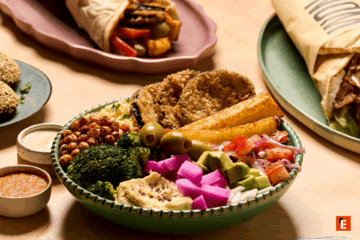
Dish’d
Restaurant Quality Virtual Brands
- Restaurant
- 70 Locations
- Liquid capital: £15000
3. Design the menu around VAT and travel time
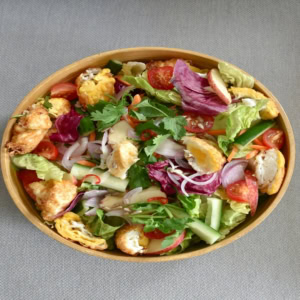
VAT is decided item by item. Under HMRC’s catering rules, hot takeaway food is standard-rated, while cold takeaway food is generally zero-rated, except confectionery, crisps, ice cream and soft drinks, which are standard-rated wherever they are sold. A delivery menu built around cold items such as salads, sandwiches or poke bowls carries a different VAT bill from one built around fried food, at the same prices. Travel time matters as much, since a delivered dish is eaten some time after it leaves the pass, and dishes that go soggy or separate on the way are the ones customers rate down.
4. Confirm the planning position in writing
There is no settled national answer on which use class a dark kitchen occupies in England. Some councils treat it as Class E(g)(iii), light industrial, which allows movement within Class E without permission; others treat it as sui generis, which means a change of use needs planning permission. The London Borough of Camden took enforcement action in June 2018 against a Deliveroo facility in Swiss Cottage, alleging an unauthorised change of use; in a later appeal against Birmingham City Council, the inspector agreed the use was sui generis but allowed the appeal because the operation suited an industrial area. A written view from the planning authority before the lease is signed is the only reliable answer.
5. Check the unit for extraction, power and riders
- Extraction and odour: the most common planning condition on this use, and often more expensive than the cooking equipment in a unit never used for food
- Power and gas: three-phase electricity or a gas supply where the menu needs it; brand licensors such as Dish’d make one of them an entry condition
- Rider access: a collection point that keeps riders off the pavement and away from neighbours’ doors, since vehicle movements through the evening draw most objections
- Waste: in England, businesses with 10 or more full-time equivalent employees have separated food waste since 31 March 2025, and smaller ones must from 31 March 2027
6. Register the food business and write the safety system
Registration goes to the local authority covering the kitchen, is free, and is due 28 days before opening; the Food Standards Agency states that trading without it is an offence, including for kitchens selling only through apps or social media. Food businesses must maintain procedures based on hazard analysis principles, and the FSA’s free Safer Food, Better Business pack is what most independents use. Temperature, cleaning, supplier and training records are what an inspector asks for, and what platforms request at onboarding.
7. Build allergen information into the order flow
Distance selling carries a duty a counter business does not. The FSA states that where food is sold online or by phone, allergen information must be available before the purchase is completed and again when the food is delivered, in writing and free of charge. Where a customer has customised a dish, the delivered information reflects it, and a business selling through a platform tells customers before they order where the information can be found. Responsibility for accuracy sits with the kitchen, not the app.
Good to know
The single-use plastics ban applies to delivery. Since 1 October 2023, businesses in England may not supply single-use plastic cutlery at all, or ready-to-eat food in polystyrene containers, and the ban covers online orders. Plastic trays and containers remain allowed when they are the packaging the food is delivered in. Trading Standards enforces it.
8. License late-night hot food
Supplying hot food to the public between 11pm and 5am is late night refreshment under the Licensing Act 2003 and needs a premises licence, whether the food is eaten on site or delivered. Medway Council’s guidance makes the practical point that the licensable moment is when the food is handed over, not when the order is taken, so last orders, cooking time and packing time all have to fall before 11pm without a licence. Councils grant delivery-only licences with conditions: a dark kitchen on an industrial estate in Wembley applied to Brent for late night refreshment off the premises to serve Uber Eats orders, and Westminster has granted late hours restricted to delivery to a customer’s home or business address. Tower Hamlets has used a test purchase against a takeaway serving hot food after 11pm without a licence.
9. Get listed, then build a direct channel
Platform access is contractual. Deliveroo’s published partner policies require a minimum food hygiene rating of 2 and state that a partner falling below it can be removed; other platforms set their own thresholds and onboarding documents. Uber Eats publishes UK fees of 30% when its couriers deliver and 13% for self-delivery or collection; other platforms set rates by contract. A direct ordering page, a Google Business Profile linking to it, and a leaflet or code in every bag are how kitchens move repeat customers off the apps, a route many of the restaurant franchises recruiting in the UK also run alongside their own sites.
10. Manage brands, menus and ratings week by week
One kitchen commonly lists several brands, which the Sheffield Hallam researchers found makes dark kitchens harder for local authorities to track and for consumers to identify. The same study found consumers want to know where their food is prepared and to see hygiene ratings and allergen details inside the apps. The food hygiene rating is published on the FSA website from 0 to 5 in England, Wales and Northern Ireland, and as Pass or Improvement Required in Scotland; display at the premises is a legal requirement in Wales and Northern Ireland and voluntary in England, but for a dark kitchen the number that matters is the one a platform or licensor checks.
Types of dark kitchen business
The Sheffield Hallam researchers recorded dark kitchens in converted industrial units, shipping containers, kitchens rented by the hour and space inside hotels, pubs and stadiums. The arrangements fall into five groups:
| Model | Who carries the planning and fit-out | Typical commitment |
|---|---|---|
| Standalone delivery-only unit | The operator | A commercial lease, often full repairing and insuring |
| Managed kitchen site | The site operator | Short leases, typically about a year at Karma Kitchen |
| Spare capacity in a restaurant | The existing business | None beyond the brand and packaging |
| Licensed virtual brand | The kitchen operator | A monthly fee or a share of orders |
| Home kitchen | The householder | Registration; platform rules usually restrict listing |
How much does it cost to open a dark kitchen in the UK?
No public or official UK source gives an average start-up cost for a dark kitchen. What can be stated are the statutory lines, the fees the platforms publish, and real asking rents.
| Cost line | Published figure |
|---|---|
| Food business registration | Free, 28 days before opening |
| Company incorporation | £100 online, Companies House fee schedule from 1 February 2026 |
| Business rates, England | Rateable value × 43.2p small business or 48.0p standard; 38.2p and 43.0p only where the property qualifies as retail, hospitality or leisure |
| Small Business Rate Relief, England | 100% at rateable value of £12,000 or less, tapering to nil at £15,000 |
| Own unit, example | £35,000 a year for a three-kitchen unit in Clapham, 2026 listing |
| Licensed brands | FoodVerse: from £499 a month for six brand licences |
| Platform fees | Uber Eats: 30% when it delivers, 13% self-delivery; others by contract |
| Staff | £12.71 an hour at 21 and over; employer NI 15% above £5,000, 0% for under-21s up to £50,270 |
The lines that move a start-up budget most are:
- Extraction, ventilation and grease management in a unit not previously used for food
- Three-phase electricity or a gas connection where the menu needs it
- Planning fees and professional support where a change of use is required
- Refrigeration, cooking equipment and compliant packaging
- Platform commission on every order, and promotional spend inside the apps
- Working capital: platforms pay out on their own cycle while suppliers and staff are paid on theirs
Dark kitchen franchise opportunities in the UK
What is sold in this sector is mostly brand licensing into a kitchen the operator already has, priced monthly or on a share of orders, rather than a franchise with an initial fee and a protected territory, the structure described in an in-depth guide to franchising in the United Kingdom.
- Dish’d, which licenses virtual brands into existing kitchens, publishes no investment figure and sets entry conditions instead: commercial extraction and gas or three-phase electricity, a fully halal kitchen, no alcohol on site, and a minimum food hygiene rating of 3. Its brands cannot be prepared from home or a light commercial kitchen

Editor’s tip
The hygiene rating is the only shopfront a dark kitchen has, and the law points it at a door no customer uses. No UK law requires the rating to be shown on a delivery app; what fills the gap is contract. Platforms and brand licensors set their own minimum ratings, Deliveroo at 2 and Dish’d at 3, so a score below theirs closes the sales channel whatever the local authority allows.
The practical difficulties operators report
- Commission sets the ceiling: at 30% on top of 20% VAT, an app-delivered order keeps a fraction of its menu price before rent and labour
- The use class is unsettled: one council treats the use as light industrial, the next as sui generis, and enforcement has followed where permission was not sought
- The customer belongs to the platform: listing, ranking and promotions run on a contract the kitchen does not write
- Late hours need a licence: hot food handed over after 11pm without one is an offence, and councils test-purchase
- Allergens are harder without a counter: the information has to be right twice, in writing, with no chance to answer a question across a till
- Neighbours notice the riders: noise, odour and vehicle movements are what objections and planning conditions concentrate on
The bottom line
Opening a dark kitchen in the UK removes the dining room and none of the food law: registration 28 days before trading, a written safety system, allergen information twice on every order, compliant packaging, and a late-night licence if hot food leaves after 11pm. The commercial test is the single order. On illustrative figures, a £15 hot order keeps about £3.55 when an app delivers it and about £7.60 through the kitchen’s own site, so the format, the menu mix and a direct channel decide whether the kitchen pays.
Frequently asked questions about opening a dark kitchen in the UK
It depends on the council. In England, some planning authorities treat a dark kitchen as Class E(g)(iii), light industrial, so a change from another Class E use may not need permission; others treat it as sui generis, which requires permission. Camden took enforcement action on that basis in 2018, and a later appeal against Birmingham City Council also found the use to be sui generis.
Yes. Registration triggers a local authority inspection, and in England, Wales and Northern Ireland that produces a rating from 0 to 5 published on the FSA website. Scotland records Pass or Improvement Required. Display at the premises is required in Wales and Northern Ireland and voluntary in England.
A home kitchen selling food commercially is a food business and must register with the local authority 28 days before trading, including when it sells only through apps or social media. The inspection and rating follow. Platforms and brand licensors then apply their own rules, and some, such as Dish’d, exclude home kitchens.
Uber Eats publishes UK fees of 30% of the order value when its couriers deliver and 13% for self-delivery or collection. Other platforms set rates by contract. On an illustrative £15 hot order, an app delivery leaves about £3.55 after VAT, food, packaging and commission, against about £7.60 through the kitchen’s own website.
Hot food sent out for delivery is standard-rated at 20%. Cold takeaway food is generally zero-rated, except confectionery, crisps, ice cream and soft drinks, which are always standard-rated. VAT registration becomes compulsory once taxable turnover passes £90,000.
Yes, if it supplies hot food between 11pm and 5am. That is late night refreshment under the Licensing Act 2003 and needs a premises licence, including for delivery-only kitchens. The licensable moment is when the food is handed over, so orders cooked before 11pm but collected after it are caught.
In England, single-use plastic cutlery and polystyrene containers for ready-to-eat food have been banned since 1 October 2023, including for online orders. Plastic trays and containers remain allowed when they are the packaging the food is delivered in. Trading Standards enforces the ban.
The food business, not the platform. The FSA requires allergen information before the order is completed and again at delivery, in writing and free of charge, and expects customised dishes to be reflected in what is delivered.
No national average is published. A three-kitchen unit in Clapham was advertised in 2026 at £35,000 a year on a full repairing and insuring lease, and managed sites such as Karma Kitchen let kitchens on short leases of about a year. Licensed brand models such as FoodVerse start from £499 a month on top of the kitchen itself.
It is set by contract, not law. Deliveroo’s partner policies require a minimum of 2 and allow removal below it, and brand licensor Dish’d requires at least 3. Other platforms set their own thresholds at onboarding.