
The U.S. cleaning services sector employs more than 3 million workers and generates over $100 billion in annual revenue, according to the U.S. Bureau of Labor Statistics. Startup costs can be as low as a few thousand dollars for a home-based business. This guide explains how to start a cleaning business in the United States in 2026, from choosing a concept to opening day.
Can Anyone Start a Cleaning Business?
Most U.S. states do not require a specialized professional license to operate a cleaning business. Registration, insurance, and local compliance are the main requirements. Startup costs can range from under $5,000 for a home-based residential business to more than $50,000 for a fully equipped commercial operation.
Cleaning businesses typically serve three segments: residential (homes and apartments), commercial (offices, retail, and other facilities), and specialized (post-construction, medical, carpet and upholstery, or pressure washing). Each requires different equipment, insurance, and expertise.
Good to know
According to the U.S. Bureau of Labor Statistics, the cleaning sector employs approximately 2.2 million janitors and building cleaners and 840,000 maids and housekeeping staff in the US (2023 data). The sector consistently ranks among the most accessible for first-time entrepreneurs due to low barriers to entry and steady demand.
8 Steps to Start a Cleaning Business in the US
Step 1: Define the Concept, Business Structure, and Target Audience
Operators must first choose their target market and legal structure, such as a sole proprietorship, LLC, general partnership, or corporation. LLCs are popular among US cleaning businesses because they help separate personal and business liabilities. State filing fees typically range from $50 to $500.
Defining a target audience at this stage, whether residential homeowners, small office operators, or property managers, shapes pricing strategy, insurance needs, and equipment requirements from the outset.
Step 2: Create a Business Plan (including Pricing)
A business plan typically documents the concept, target market, competitive analysis, service offerings, pricing structure, and financial projections. For those seeking SBA loans or private financing, lenders generally request this document as part of the application process. The SBA’s Business Plan Tool at sba.gov provides free templates and guidance for small business owners.
Pricing models in the cleaning sector commonly include hourly rates, flat per-job fees, and recurring contract pricing. Factors that typically influence rates include:
- Square footage and number of rooms in the property
- Frequency of service (one-time, weekly, monthly)
- Type of cleaning (standard maintenance, deep clean, post-construction)
- Number of cleaners assigned to the job
- Local market rates and competitive pricing in the area
Step 3: Find a Location or Go Home-Based
Many cleaning businesses launch from a home-based setup, with the owner storing equipment at a residential address and traveling to client sites. This approach reduces overhead significantly in the early stages. Operators running a business from home may need a home occupation permit depending on local zoning regulations; requirements vary by city and county.
Businesses that scale into larger commercial operations sometimes lease a small commercial space for vehicle parking, supply storage, and staff coordination. In most states, a physical commercial address is not required to register a cleaning business.
Step 4: Secure Permits and Licenses
Licensing requirements for cleaning businesses vary by state and municipality. Most states do not issue a specialized cleaning license. The common compliance steps across the US include:
- Business license: issued at the city or county level; required in most jurisdictions before operations begin
- DBA (“doing business as”) filing: required when operating under a trade name different from the owner’s legal name; filed with the state or county clerk
- EIN (Employer Identification Number): issued by the IRS at no charge via irs.gov; required for LLCs, corporations, and any business with employees
- Home occupation permit: required in some jurisdictions for businesses operating from a residential address
- Sales tax registration: cleaning services are subject to sales tax in some states; rules vary by state and may change over time
- Surety bond: not universally required by law but frequently requested by commercial clients before a contract is signed; annual premium typically ranges from $100 to $250 for $10,000 to $25,000 in coverage
- General liability insurance (annual): typical premiums range from $400 to $1,500 for small operators; required by most commercial clients and recommended for all business models
- Workers’ compensation insurance: required in most states as soon as the first employee is hired; rates vary by state and payroll level — guidance available at each state’s workers’ compensation board
- OSHA compliance: cleaning businesses must comply with the Hazard Communication Standard (chemical labeling and Safety Data Sheets for all products used) and, where applicable, the Bloodborne Pathogens Standard; written safety plans and documented staff training are required — see osha.gov
- EPA Renovation, Repair, and Painting (RRP) firm certification: required when working in pre-1978 homes or child-occupied facilities; firm certification costs $300 per five years via EPA.gov
The Small Business Administration provides a licenses and permits search tool at sba.gov that allows operators to look up requirements by state and business type.
Regulatory note
Businesses with employees may also be subject to Beneficial Ownership Information (BOI) reporting requirements with FinCEN under the Corporate Transparency Act. Requirements and deadlines vary; official guidance is available at fincen.gov.
Step 5: Procure Supplies and Equipment
Equipment and supply needs depend on the segment served. A basic residential cleaning operation typically requires vacuum cleaners, mops and buckets, microfiber cloths, carrying caddies, general-purpose cleaners, glass cleaner, disinfectants, and personal protective equipment such as gloves and aprons.
Commercial and office cleaning operations often require additional equipment: commercial-grade vacuums, floor buffers, pressure washers, and industrial chemical products. Some operators purchase supplies at wholesale prices through distributors affiliated with ISSA (the International Sanitary Supply Association) to manage ongoing input costs.
Step 6: Organize Operations and Hire Staff
Businesses that expand beyond a solo operation face additional compliance steps. Employers in the US are required to carry workers’ compensation insurance for all employees; requirements and rates vary by state. Many states also mandate short-term disability coverage for employees. The US Department of Labor provides state-by-state guidance on employer obligations at dol.gov.
Operational documents that cleaning businesses commonly establish before hiring include:
- Service contracts and scope-of-work templates that define what is and is not included in each cleaning
- Cancellation and no-show policies
- Employee or independent contractor agreements
- Background check procedures, commonly requested by residential clients and property managers
Step 7: Launch Marketing
New cleaning businesses typically use a combination of digital and local channels to acquire early clients. Common approaches at launch include a Google Business Profile listing (free), a basic website with local SEO, neighborhood social media outreach, referral programs, and listings on local service directories. Commercial operators often pursue contracts through direct outreach to property managers, office managers, and facilities directors.
Promotional pricing for first-time clients is a practice observed across many cleaning businesses at launch, with some operators offering a discounted first cleaning or a free add-on service in exchange for a review or referral.
Step 8: Open Your Cleaning Business
Before taking on first clients, operators generally complete a final compliance checklist: insurance certificates are confirmed, service contracts are signed, equipment is in place, and any required permits have been issued. Commercial cleaning operators are often required to provide certificates of insurance and bonding documentation before a first appointment.
Opening a business bank account, separate from personal finances, is a standard step at this stage. Corporations and LLCs in most states are required by law to maintain separate business financial accounts to preserve liability protection.
Is It Also Possible to Open a Cleaning Business as a Franchise?
Franchising is an established route into the U.S. cleaning sector, with a wide range of home cleaning franchises and commercial cleaning franchises. Some examples:
Stratus Building Solutions
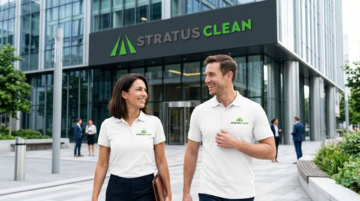
Stratus Building Solutions is a commercial cleaning franchise focused on environmentally friendly services. Unit franchise investments range from approximately $4,725 to $79,750. The brand ranked #1 among commercial cleaning franchises in Entrepreneur’s 2026 Franchise 500.
Stratus Clean
Green commercial cleaning
- Commercial Cleaning
- 5500 Locations
- Liquid capital: $125000
Jan-Pro
Jan-Pro is a commercial cleaning franchise operating through a master-franchise model. The initial investment range is $4,170 to $56,020 (Source: Jan-Pro FDD). The brand has been listed among top cleaning franchises in the Entrepreneur Franchise 500.

JAN-PRO
Clean. Safe. Healthy
- Business Services
- Not disclosed
- Liquid capital: $Not disclosed
Molly Maid
Molly Maid id the leading residential cleaning franchise in the US, part of the Neighborly network. The initial investment range is $144,150 to $203,950, with royalty fees of approximately 2% of gross sales (Source: Molly Maid FDD, 2026).
Molly Maid
Reclaim Your Time. Enjoy Your Home.
- Personal Services
- Not dosclosed
- Liquid capital: $60000
Merry Maids
Merry Maids is a residential cleaning franchise founded in 1979, operating across the US, UK, and Canada. Royalty fees are approximately 7% of gross sales.
Merry Maids
More freedom to be you
- Personal Services
- Not disclosed
- Liquid capital: $Not disclosed
Coverall
Coverall
Coverall is a commercial cleaning franchise offering professional janitorial services and ongoing training and business support. The estimated initial investment ranges from $17,917 to $64,048

Coverall
A Cleaner, Healthier Work Environment
- Business Services
- Not disclosed
- Liquid capital: $Not disclosed
The FTC’s Consumer’s Guide to Buying a Franchise (ftc.gov) outlines the key items to review in a Franchise Disclosure Document (FDD), including Item 7 (initial investment), Item 12 (territory rights), and Item 19 (financial performance representations). Under the FTC Franchise Rule, franchisors are required to provide a FDD to prospective franchisees at least 14 calendar days before any agreement is signed.
How Much Will It Cost to Start a Cleaning Business in the US in 2026?
Startup costs for an independent cleaning business vary significantly depending on the business model, segment, and geographic market. The table below provides a breakdown of typical expenses for an independent operation.
| Expense Item | Estimated Cost Range |
|---|---|
| Business registration / LLC filing | $50 to $500 |
| Business license (city or county) | $50 to $400 |
| EIN (Employer Identification Number) | Free (IRS) |
| General liability insurance (annual) | $500 to $2,000 |
| Surety bond (annual) | $100 to $500 |
| Workers’ compensation (if hiring employees) | Varies by state and payroll |
| Basic cleaning supplies and equipment | $200 to $1,500 |
| Commercial-grade equipment (vacuums, floor machines) | $2,000 to $10,000+ |
| Website and initial marketing | $200 to $2,000 |
| Working capital reserve (3 months) | $1,000 to $5,000 |
| Total — home-based solo operation | $2,000 to $6,000 |
| Total — small team operation | $5,000 to $15,000 |
| Total — commercial cleaning operation | $10,000 to $50,000+ |
Sources: SBA.gov (loan and registration data), IRS.gov (EIN), Insurance Canopy (insurance cost ranges), industry operator reports
Cleaning Business Startup Costs: Independent vs. Franchise
The second table compares the cost structure of an independent cleaning business against a franchise model.
| Item | Independent Cleaning Business | Franchise Cleaning Business |
|---|---|---|
| Initial investment range | $2,000 to $50,000+ | $4,170 (Jan-Pro) to $203,950 (Molly Maid) |
| Franchise fee | None | Included in total initial investment |
| Ongoing royalty fees | None | 2% to 10% of gross sales (varies by brand) |
| Brand recognition at launch | Built from scratch | Established national or regional brand |
| Training provided | None (self-directed) | Typically included in franchise package |
| Territory protection | None | Defined in FDD; varies by brand |
| Pricing flexibility | Full control | Subject to brand guidelines and standards |
| Marketing support | Independent | Typically provided by franchisor |
Sources: Jan-Pro FDD, Molly Maid FDD (2026), FTC.gov (FDD requirements), IFA (ifa.com)
Key factors that affect total startup costs include:
- Business model: solo home-based vs. multi-crew commercial operation
- State and local fees: registration costs, permit fees, and sales tax registration requirements
- Insurance coverage levels: general liability limits, workers’ compensation, and bonding requirements
- Equipment requirements: basic residential supplies vs. commercial-grade machinery
- Vehicle needs: personal vehicle vs. branded commercial van or fleet
- Marketing investment: organic and paid acquisition strategies at launch
Frequently asked questions about starting a cleaning business in the US
Most US states do not require a specialized professional cleaning license. However, a general business license is typically required at the city or county level, and additional permits such as a home occupation permit or DBA filing may apply depending on the business setup and location. Requirements vary by state and municipality.
A home-based solo cleaning operation can typically be launched for between $2,000 and $6,000, covering business registration, a general liability insurance policy, basic cleaning supplies and equipment, and initial marketing costs. Operators who start with minimal equipment and a single residential client base often begin at the lower end of this range.
General liability insurance is the most common baseline coverage for cleaning businesses, protecting against claims related to property damage or client injuries during a job. Businesses with employees are typically required by state law to carry workers’ compensation insurance. Many commercial clients also require a surety bond before signing a contract. Disability insurance requirements for employees vary by state.
The franchise route provides access to an established brand, training, and marketing support, but involves higher upfront investment, franchise fees, and ongoing royalty payments ranging from 2% to 10% of gross sales. An independent business involves lower initial costs and full pricing flexibility, but requires building brand recognition from scratch. The choice between the two models depends on factors including available capital, business experience, and target market.
This content is provided for informational purposes only and does not constitute legal, tax, financial, or professional advice. Laws and regulations vary by state and individual circumstances and may change over time. Readers should consult a qualified attorney, tax professional, or other licensed professional regarding their specific situation. Nothing herein creates an attorney-client relationship.