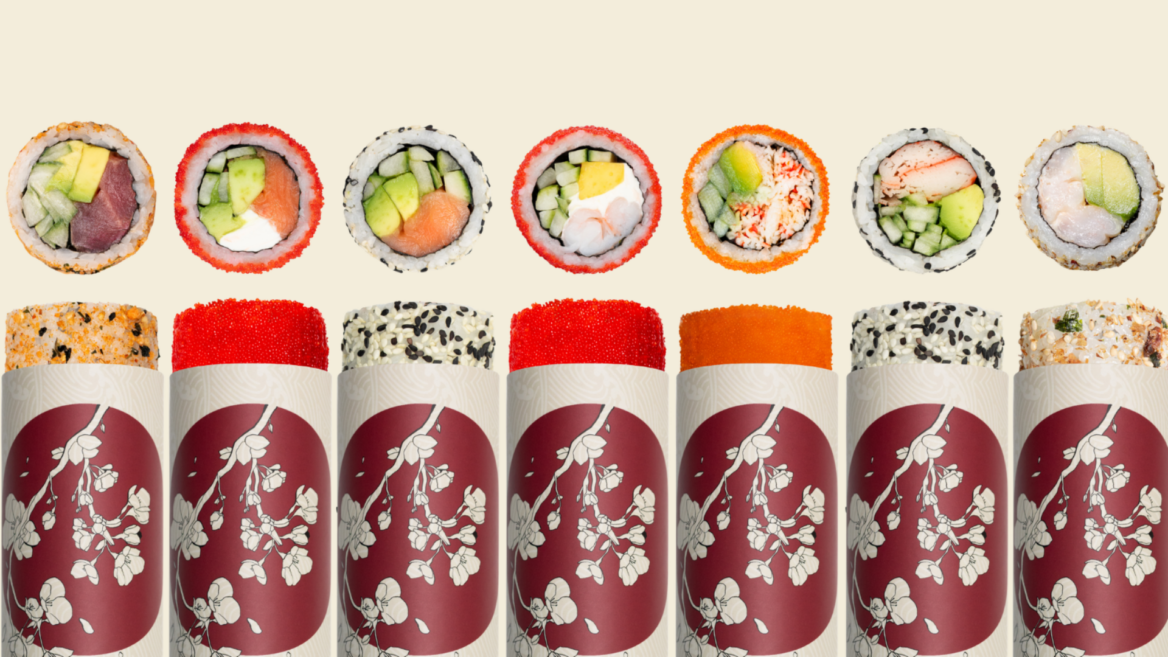

A patent-pending tube that pushes a sushi roll up bite by bite turned a small Manhattan storefront into a social video destination in late 2025. Suka Sushi now runs two takeout locations in New York City, and neither is a franchise. This article covers the concept, how the company is structured, and which US sushi brands do sell franchises.
Sushi now sells from far more than the standalone Japanese restaurant in the United States: grocery counters, food halls and takeout windows all carry it. That spread is why a viral single-city concept and a national franchise system turn up in the same searches. The two are not the same thing.
What is Suka Sushi?
Suka Sushi is a takeout sushi concept operating at 61 Lexington Avenue and 55 Spring Street in Manhattan. On its own website, the company describes the business as reinventing takeout sushi with patent-pending to-go packaging. The roll sits in a cylinder the customer pushes up from the bottom, and soy sauce arrives in a sealed straw-shaped tube, which takes chopsticks and trays out of the transaction.
Service is first come, first served, with limited daily availability, and the shops close once they sell out. In December 2025, News 12 New York reported on the format, with the owner explaining that the aim was to take bulky containers, chopsticks and spills out of eating sushi on the move. Attention on TikTok followed.
Is Suka Sushi a franchise company?
No, Suka Sushi does not operate as a franchise system
Suka Sushi publishes no franchise offer for the United States. Its website carries no franchising section, no candidate application and no Franchise Disclosure Document. Under the FTC Franchise Rule, 16 CFR Part 436, a company that sells no franchises files no FDD, so the absence of one is the finding.
How the company is structured and operates
What is publicly documented comes from the brand itself: two Manhattan addresses, one menu format built around the proprietary container, and a catering line. Both shops run the same takeout-only footprint, with no seating to manage. The company has not announced third-party ownership of either location, an area development program, or a license allowing outside operators to use the packaging.
Good to know
A company can license a product, a recipe or a piece of packaging without franchising. Under the FTC Franchise Rule, three elements must all be present: use of the brand’s trademark, significant control over or assistance with the operator’s method of operation, and a required payment of $500 or more within six months of opening. An agreement missing one of the three is not a franchise.
US sushi brands that do operate as franchise systems
Several US sushi concepts do sell franchises and file disclosure documents. The figures below come from each brand’s listing in Entrepreneur’s franchise directory, which draws on the brands’ FDDs. The authoritative numbers sit in Item 5 of the current FDD for the initial fee and Item 7 for the investment range.
- Initial franchise fee: from $25,000 to $36,000 across the four brands below
- Total initial investment: from $139,300 to $801,000, depending on brand and format
- Royalty: 5% to 6% of sales, plus an advertising contribution of 1% to 2.5%
Rock N Roll Sushi
Founded in 2010 and franchising since 2015, the Alabama-born full-service brand counts 73 units. Its Entrepreneur directory listing gives an initial fee of $36,000, a total initial investment of $332,682 to $797,808, a 6% royalty, and requirements of $500,000 net worth and $150,000 liquid capital.
Sushi Song
Founded in 2009 and franchising since 2022, the brand reports eight units. Its listing gives an initial fee of $25,000 to $35,000, a total initial investment of $139,300 to $533,500, a 5% royalty and a 1% advertising fee, the lowest entry range of the four.
Komotodo Sushi Burrito
A sushi burrito format founded in 2014, franchising since 2017, with two units. Its listing gives a $30,000 initial fee, a total initial investment of $167,650 to $438,500, a 5% royalty and a $400,000 net worth requirement.
SanSai Fresh Grill & Sushi Kitchen
Operating and franchising since 2002, the brand pairs grilled dishes and salads with sushi. Its listing gives a $35,000 initial fee, a total initial investment of $440,900 to $801,000, a 5.5% royalty and $100,000 to $150,000 in liquid capital.
The sector spans both ends of the ownership question: independents such as Suka Sushi, which sell nothing to outside operators, and franchised systems whose entry terms are filed year by year.
Frequently asked questions about Suka Sushi and sushi franchises
No. Suka Sushi publishes no franchise offer and no Franchise Disclosure Document. The brand runs two takeout locations in Manhattan, at 61 Lexington Avenue and 55 Spring Street.
There is no published national average. Each brand states its own range in Item 7 of its current FDD. Among the four brands listed above, total initial investment runs from $139,300 to $801,000 and initial fees from $25,000 to $36,000.
This content is provided for informational purposes only and does not constitute legal, tax, financial, or professional advice. Laws and regulations vary by state and individual circumstances and may change over time. Readers should consult a qualified attorney, tax professional, or other licensed professional regarding their specific situation. Nothing herein creates an attorney-client relationship.