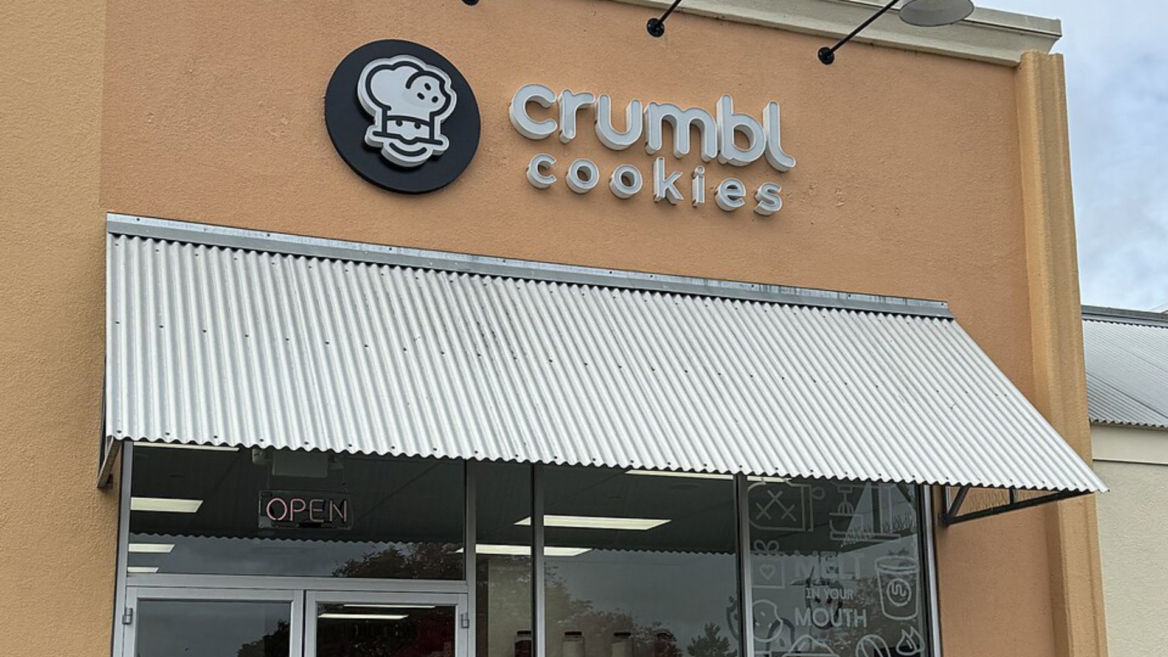

Multiple Crumbl Cookie franchise locations closed across the United States in early October 2025, with some franchisees filing for Chapter 7 bankruptcy protection. The wave of closures arrives as Crumbl’s median average unit volume declined approximately 16% in a single year, from $1.35 million in 2024 to $1.09 million in 2025, according to analysis of the brand’s Franchise Disclosure Document published by QSR Magazine.
Crumbl was founded in 2017 by cousins Jason McGowan and Sawyer Hemsley in Logan, Utah. The brand grew from a single location to more than 900 franchise locations in roughly six years, built on a rotating weekly menu of specialty cookies and an immediately recognizable pink box that drove social media visibility.
The expansion was among the fastest in American franchise history, and Crumbl’s model attracted significant franchisee investment before growth in unit economics began to slow. The October 2025 closures and bankruptcy filings bring renewed scrutiny to the relationship between the brand’s aggressive development pace and the per-unit financial performance its franchisees have been able to sustain.
The Closures: What Is Known as of October 2025
Multiple Crumbl locations in several U.S. states closed without advance notice to customers in early October 2025. Some of the closures were accompanied by Chapter 7 bankruptcy filings by individual franchisees, a process that liquidates a business’s assets rather than restructuring them under Chapter 11. Chapter 7 filings by franchise operators typically signal that a unit’s liabilities have exceeded what the franchisee considers recoverable through continued operation.
Crumbl’s corporate leadership has not issued a consolidated public statement on the scope of the closures. The number of locations affected as of the date of publication has not been officially confirmed by the franchisor. Accounts from local news outlets and franchisee communities indicate that the closures span multiple markets, including some that had previously been cited as strong performance areas for the brand.
What the FDD Shows: A Declining Average Unit Volume
Analysis of Crumbl’s Franchise Disclosure Document by QSR Magazine indicates that the brand’s median average unit volume (AUV) fell from approximately $1.35 million in fiscal year 2024 to approximately $1.09 million in fiscal year 2025. That represents a decline of roughly 16% in a single year. FDD Item 19 financial performance representations are one of the primary data sources available to prospective franchisees evaluating a brand, and declining AUV figures are material to those evaluations.
Crumbl’s AUV decline reflects a pattern seen in several high-growth specialty food concepts that expanded rapidly during the 2020 to 2023 period: initial unit performance driven by novelty and social media attention tends to normalize as locations mature and local market saturation increases. For franchisees who projected returns based on peak-period AUV figures, the gap between projected and actual performance can become operationally unsustainable.
Crumbl median AUV decline in one year
The brand’s median average unit volume dropped from approximately $1.35 million (2024) to $1.09 million (2025), according to FDD analysis by QSR Magazine.
The Investment Gap: High Entry Costs Against Lower Returns
Crumbl’s Franchise Disclosure Document (FDD) estimates initial investment at $848,000–$1.47 million per location. Against median AUV of $1.09 million, the investment burden—particularly at the high end—raises concerns about payback timelines and profitability.
With a 7% royalty and 2% marketing fee, franchisees surrender 9% of gross sales before covering rent, labor, and ingredients. This leaves limited margin for underperformance. The October 2025 closures may partly reflect franchisees who expanded during peak growth but struggled to maintain profitability as sales volumes declined.
A Pattern the Franchise Sector Has Seen Before
Crumbl’s challenges mirror a broader pattern among fast-growing franchise concepts: social media drives rapid expansion, early unit economics attract investors, and sales normalize as novelty fades and markets become saturated.
Growing competition in the specialty cookie market further fragments demand. Crumbl’s recovery will depend partly on its response, including potential franchisee support, royalty relief, or revised development agreements. As of early October 2025, Crumbl had not publicly announced any such programs.
This content is provided for informational purposes only and does not constitute legal, tax, financial, or professional advice. Laws and regulations vary by state and individual circumstances and may change over time. Readers should consult a qualified attorney, tax professional, or other licensed professional regarding their specific situation. Nothing herein creates an attorney-client relationship.