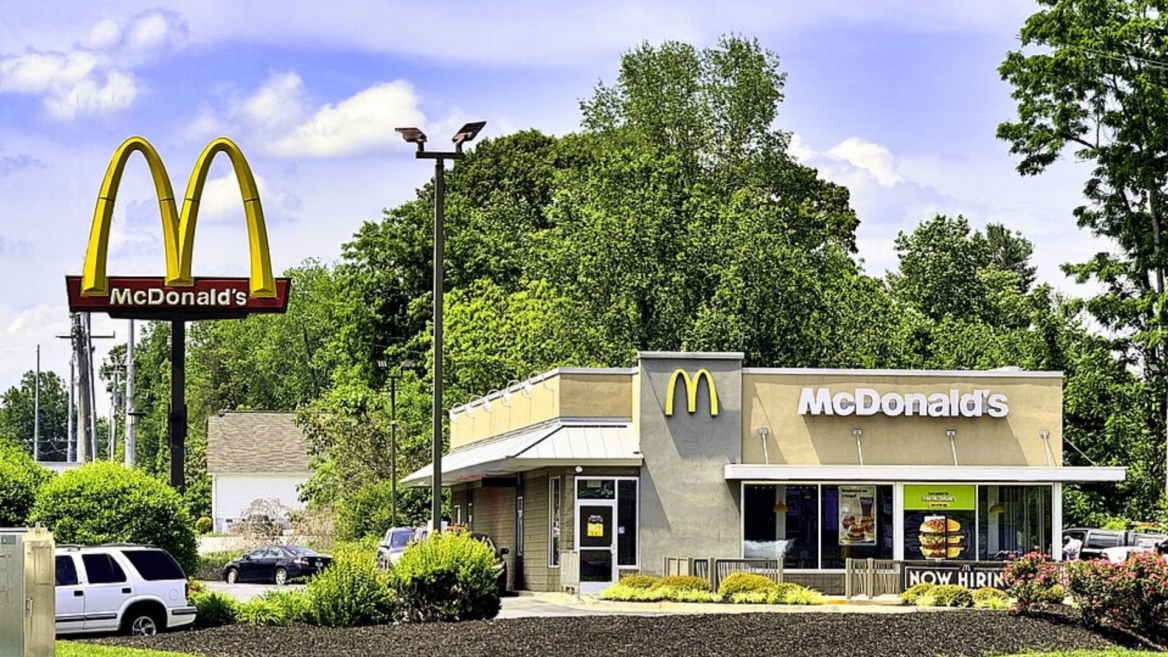

McDonald’s has unveiled an $8.5 billion franchisee support program running through 2036, with $5 billion committed by 2030. The plan distributes rent relief and direct capital across 13,500 U.S. franchised restaurants, projecting an average annual cash flow improvement of $100,000 per unit. The announcement arrives as domestic same-store traffic continues to fall and the stock trades down more than 20% year to date.
The September 23 announcement arrives against a difficult backdrop for McDonald’s domestic operations. U.S. same-store traffic fell 4.6% year over year in August, following a 6% drop in July. Comparable sales grew just +0.8% in the most recent quarter, a figure that contrasts sharply with competitor Burger King, which reported +8.5% comparable sales growth over the same period. McDonald’s stock fell an additional 5% on the day of the announcement, reflecting investor concern about the depth and duration of the consumer slowdown affecting the chain’s U.S. franchise restaurants.


Burger King
“Have It Your Way.”
- Restaurant
- Liquid capital: $


McDonald’s
I’m Lovin’ It
- Restaurant
- Not disclosed
- Liquid capital: $750000
The Support Package: Rent Relief, Capital Investment, and a Four-Year Payback
The program operates through two primary channels: rent reductions on McDonald’s-owned properties leased to franchisees, and direct capital support for restaurant operations and improvements. The company projects an average annual cash flow improvement of $100,000 per U.S. restaurant and a four-year payback on invested capital.
Alongside the financial commitment, McDonald’s announced the appointment of Skye Anderson as the new president of McDonald’s USA, a structural change that signals a renewed focus on the domestic franchise network. CEO Chris Kempczinski characterized the operating environment as one where both inflation and lower consumer traffic are expected to persist into the near term.
A Traffic Slump That Has Outlasted the Post-Pandemic Recovery
McDonald’s U.S. traffic decline is not a new development. Consumer spending in the quick-service restaurant sector has been under sustained pressure from rising food-at-home costs that have narrowed the price gap with dining out. The brand’s value proposition, historically a primary driver of traffic, has faced scrutiny from consumers who have shifted toward competing chains or reduced away-from-home meals altogether.
Burger King’s recent comparable sales outperformance underscores the competitive intensity in the fast-food segment at a time when McDonald’s traffic is falling. The franchisee support program is designed to give operators more financial runway to invest in customer experience, menu execution, and local marketing at the unit level.
The Scale of the Commitment Across 13,500 Franchised Units
With 13,500 franchised locations across the United States, McDonald’s operates one of the largest franchise networks in the world. The $8.5 billion commitment over ten years positions the program among the most significant franchisor-to-franchisee financial packages in quick-service restaurant history. A
t the projected $100,000 average annual cash flow improvement per unit, the aggregate benefit to operators at full run rate would amount to roughly $1.35 billion per year. Whether that improvement translates into customer experience gains, traffic recovery, or margin preservation will depend on how individual operators allocate the support and on broader macroeconomic conditions.
Key Signals the Industry Will Be Watching
Analysts and franchise industry observers will track several indicators in the months ahead: whether rent relief materially improves franchisee cash flow, how new U.S. president Skye Anderson shapes the domestic strategy, and whether the program changes the trajectory of same-store traffic.
McDonald’s has committed to front-loading the deployment, with $5 billion targeted before the end of 2030. Quarterly earnings releases and updates to the company’s franchise disclosure document will be the primary public data points for measuring progress against those targets in the coming years.
This content is provided for informational purposes only and does not constitute legal, tax, financial, or professional advice. Laws and regulations vary by state and individual circumstances and may change over time. Readers should consult a qualified attorney, tax professional, or other licensed professional regarding their specific situation. Nothing herein creates an attorney-client relationship.