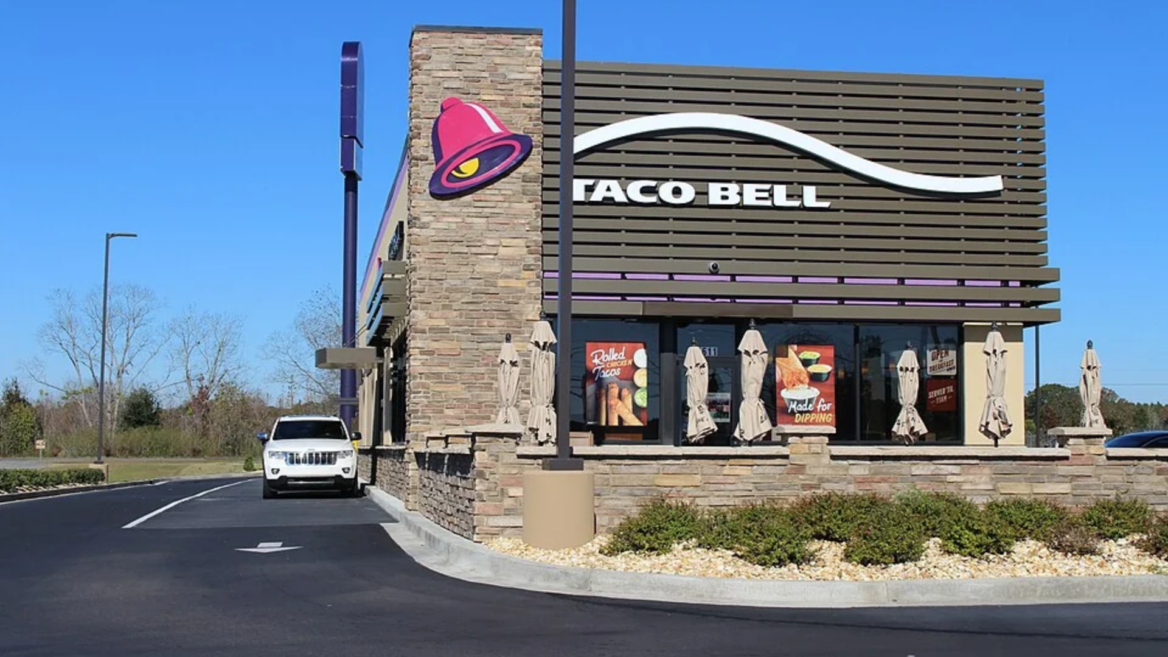

Per Item 7 of the 2026 Taco Bell Franchisor, LLC FDD (issued March 2026), a new freestanding Traditional Taco Bell costs $1,859,750 to $4,312,200. An In-Line or End-Cap unit costs $934,750 to $1,815,200. Taco Bell recruits experienced multi-unit operators rather than first-time buyers. The franchise brand counted 9,030 restaurants worldwide at the end of 2025, of which 86% are in the U.S., with roughly 8% of U.S. units operated by Yum! Brands per its 2025 Form 10-K.

Taco Bell
Live Más
- Restaurant
How Much Does a Taco Bell Franchise Cost? (2026 FDD, Item 7)
Item 7 of the 2026 Taco Bell Franchisor, LLC Traditional FDD lists the estimated initial investment by format. The Traditional freestanding unit range includes the $45,000 initial franchise fee and, for the first unit only, $27,250 in construction services paid to a Taco Bell affiliate. The In-Line or End-Cap format carries a $25,000 initial fee.
| Format | Estimated Initial Investment (Item 7) | Initial Franchise Fee (Item 5) |
|---|---|---|
| Traditional (freestanding) | $1,859,750 to $4,312,200 | $45,000 |
| In-Line or End-Cap | $934,750 to $1,815,200 | $25,000 |
Source: 2026 Taco Bell Franchisor, LLC Traditional FDD, Items 5 and 7 (issued March 2026).
| Line Item (Traditional freestanding unit, 2026 FDD Item 7) | Range |
|---|---|
| Background check (per person) | $500 to $700 |
| Initial franchise fee | $45,000 |
| First-unit construction services (affiliate) | $27,250 |
| Optional real estate services | $10,000 to $37,250 |
| Permits, licenses, deposits | $75,000 to $150,000 |
| Real property | $250,000 to $1,400,000 |
| Building and site work | $1,000,000 to $2,000,000 |
| Equipment, signage, décor, POS | $400,000 to $577,000 |
| Initial inventory | $7,000 to $10,000 |
| Grand opening | $5,000 |
| Additional funds for 3 months | $40,000 to $60,000 |
Source: 2026 Taco Bell Franchisor, LLC Traditional FDD, Item 7 (March 2026).
Within the Traditional range, the main driver is whether the franchisee purchases the land or signs a ground lease. Construction market conditions in the development area and state permitting cycles also move the final figure, as does the drive-thru configuration. A ground lease shifts the real property line to the lower end. Purchasing land in a high-cost market pushes toward the upper bound.
Item 10 of the 2026 FDD states that Taco Bell does not offer financing directly or indirectly. Franchisees fund the investment through conventional QSR lenders or SBA-eligible loans, with private capital filling specific gaps in some deals.
Good to know
Search engine snippets and AI Overviews often quote a combined “$935K to $4.3M” Taco Bell franchise cost. That range mixes the In-Line low end with the Traditional high end. The 2026 FDD lists each format separately. Older ranges, including $575,600 to $3,370,100 and $525,100 to $2,622,400, come from the 2019 to 2022 FDDs and should not be presented as current.
Taco Bell Express and Non-Traditional Formats
Taco Bell Express and Power Pumper units operate inside travel centers, campuses, airports, convenience stores, and other non-traditional venues. A separate 2026 Taco Bell Express FDD governs these formats.
- A Taco Bell Express unit carries an estimated initial investment of $287,950 to $857,700 per Item 7, with a $22,500 initial license fee.
- A Power Pumper unit runs $354,850 to $772,700 per Item 7.
- An existing-unit acquisition from Taco Bell or an affiliate runs $152,250 to $1,766,250 or more, excluding real property.
The Express license uses a different fee structure from the Traditional model. The 2026 Express FDD sets a 10% “Period License Fee” on gross sales and a 10-year term, versus a 5.5% Period Franchise Fee for Traditional units. The Go Mobile prototype (two drive-thru lanes, one reserved for mobile-order pickup, with a smaller dining room or none) is priced inside the Traditional FDD range rather than carrying a separate line, so the smaller footprint does not reduce the investment proportionally.
Many aggregator pages present the Express investment and 10% fee as the headline Taco Bell cost. These figures apply only to Express and Power Pumper licenses, not to Traditional freestanding, In-Line, or End-Cap units.
Taco Bell Royalties and Ongoing Fees (2026 FDD, Item 6)
The recurring fees for a Traditional Taco Bell unit are disclosed in Item 6 of the 2026 FDD. Taco Bell uses a 28-day accounting period, with 13 periods per year.
| Ongoing Fee | Rate or Amount | Basis / Cadence |
|---|---|---|
| Period Franchise Fee (royalty) | 5.5% of gross sales | Per 28-day accounting period |
| Advertising contribution | 4.25% of gross sales | Per 28-day accounting period |
| Combined royalty plus advertising | 9.75% of gross sales | Before technology fees |
| All Access fee | $750 | Annual |
| Transfer and renewal fees | As stated in the current FDD | Occasional |
Source: 2026 Taco Bell Franchisor, LLC Traditional FDD, Item 6. Writers should verify the current technology and software fee amounts directly against the FDD, since secondary sources disagree.
Translated into dollars, a Traditional unit running at $2 million in annual sales pays approximately $195,000 in combined royalty and advertising contributions. Technology and software fees sit on top of that figure. Item 17 of the 2026 FDD governs the franchise term, which runs up to 20 to 25 years for a Traditional unit. Readers can confirm the exact term and renewal mechanics in Item 17 of the current FDD. The Express royalty of 10% applies only to Express and Power Pumper licenses.
Taco Bell Franchise Requirements for 2026 Applicants
The current financial minimums are published on tacobell.com/franchise, not in the FDD itself. According to the brand’s franchise development page, candidates need:
- $5,000,000 personal net worth.
- $2,000,000 personal liquidity, defined on the same page as “cash or any assets that can be converted to cash within 10 business days.”
- Multi-unit operations experience, preferably in quick-service restaurants.
- Access to capital for new development or acquisitions.
- A long-term investment horizon.
- A growth mindset covering both new builds and acquisitions.
Net worth refers to the value of a candidate’s assets minus liabilities. Liquid capital refers to cash or near-cash assets that can be deployed quickly. Taco Bell’s development process targets experienced multi-unit operators and sells new development packages and existing-restaurant acquisitions rather than single units to first-time franchisees.
Partners and investor groups can combine assets to meet the thresholds. Candidates considering a partnership structure typically confirm the exact pooling rules with Taco Bell’s development team.
Many SERP results still cite $1,500,000 net worth and $750,000 liquid assets as Taco Bell’s minimum. Those figures reflect the 2022 FDD era. The current requirement on tacobell.com/franchise is $5 million in net worth and $2 million in liquidity.
How Much Does a Taco Bell Franchise Make? (Item 19 and Unit Volumes)
Item 19 is the FTC-required section of the FDD where franchisors may disclose Financial Performance Representations (FPRs). Under 16 CFR §436.5(s), earnings claims must appear exclusively in this section and cannot be made by sales teams elsewhere.
According to industry analysts, Taco Bell’s 2026 Traditional FDD describes site-forecasting tools, including Bell Point, Kalibrate, and Site Zeus, but does not disclose average sales. Some secondary sources report median unit revenue of $2,304,197 for FY2025. The 2026 Express FDD makes no FPRs. Prospective franchisees should verify all figures against the current FDD.
Taco Bell’s U.S. same-store sales grew 7% in 2025, while restaurant-level margins reached approximately 24%. Yum! Brands’ 2025 Annual Report also sets a long-term target of approximately $3 million in U.S. average unit volume by 2030. These are system-level benchmarks, not guarantees of individual franchisee performance.
Prospective franchisees should request detailed unit economics from Taco Bell’s development team and contact existing franchisees listed in Item 20 to discuss actual sales and profitability.
Editor’s tip
Owner-income figures circulated on many franchise blogs (“$80K to $100K per store”, “$300K to $500K per location”) have no primary source. The FTC Franchise Rule (16 CFR §436.5(s)) confines any earnings claim to Item 19 of the FDD. Readers evaluating profitability should rely on the current Item 19 filing and on direct conversations with Item 20 franchisees.
How to Open a Taco Bell Franchise: Steps to Apply
- Confirm financial and experience criteria. The current thresholds on tacobell.com/franchise are $5 million net worth, $2 million liquidity, and multi-unit QSR operational experience.
- Submit the inquiry form on tacobell.com/franchise. The brand’s development team reviews submissions and contacts qualified candidates.
- Development discussions and background checks. Taco Bell’s team conducts background and credit reviews; the per-person fee is disclosed in Item 7 of the FDD.
- Receive the FDD. The FTC Franchise Rule requires the franchisor to deliver the FDD at least 14 calendar days before the franchisee signs any binding agreement or pays any money. This is a pre-sale disclosure period, not a right to cancel after signing.
- Due diligence. Prospective franchisees typically engage a franchise attorney and accountant, review the full FDD (particularly Items 5 through 10, 17, 19, and 20), and call current franchisees listed in Item 20.
- Secure financing. ROBS carries specific IRS and Department of Labor compliance requirements.
- Site approval, agreement signing, training, and opening. Candidates complete site selection, execute the franchise agreement, finish required training, and open the restaurant.
In registration states such as California, New York, Illinois, Maryland, Minnesota, Virginia, Washington, and Wisconsin, the FDD is also filed with the state regulator. These public filings let prospective franchisees read current FDDs at no cost through portals such as California DFPI DocQNet, Wisconsin DFI Franchise Search, and Minnesota CARDS. Most franchisees also form an LLC with the Secretary of State and obtain an Employer Identification Number (EIN) from the IRS before signing.
Taco Bell vs. Similar QSR Franchises in the U.S.
The table below compares Taco Bell with other established U.S. fast food franchises in overlapping formats. All figures come from each brand’s own current FDD. Average and median figures are noted separately because they are not directly comparable.
| Brand | FDD Year | Item 7 (comparable freestanding) | Franchise Fee | Royalty | Item 19 Figure |
|---|---|---|---|---|---|
| Taco Bell (Traditional) | 2026 | $1,859,750 to $4,312,200 | $45,000 | 5.5% | Per Item 19 of current FDD |
| KFC | 2026 | $2,107,575 to $4,155,000 | $45,000 | Per Item 6 | $1,346,365 system average |
| Wendy’s | 2025 | $1,580,457 to $3,105,000 | Per Item 5 | Per Item 6 | $2,108,454 average |
| Burger King | 2026 | Traditional average $1,692,549 | Per Item 5 | Per Item 6 | $1,692,549 traditional average |
| Popeyes | 2025 | $1,222,045 to $3,923,245 | $50,000 | Per Item 6 | $1,974,468 average |
| Jack in the Box | 2026 | $1,909,500 to $4,041,500 | Per Item 5 | Per Item 6 | $1,913,335 average |
| Del Taco | 2025 | $1,497,200 to $3,321,000 | Per Item 5 | Per Item 6 | Per Item 19 |
Sources: each brand’s current FDD; figures cross-referenced with Entrepreneur Franchise 500 directory. Averages and medians are not directly comparable, so readers consulting the FDD should confirm which metric is used.
Del Taco is the closest Mexican quick-service competitor by investment range. Candidates who do not meet Taco Bell’s $5 million net worth and $2 million liquidity thresholds sometimes consider Moe’s Southwest Grill or Qdoba, which have lower minimums per their own FDD disclosures. Chipotle does not franchise; its U.S. restaurants are all company-operated.
Per Item 7 of the 2026 Traditional FDD, a new freestanding Taco Bell costs $1,859,750 to $4,312,200, and an In-Line or End-Cap unit costs $934,750 to $1,815,200. The 2026 Express FDD puts an Express unit at $287,950 to $857,700 and a Power Pumper at $354,850 to $772,700.
The initial franchise fee is $45,000 for a Traditional freestanding unit and $25,000 for an In-Line or End-Cap unit, per Item 5 of the 2026 Traditional FDD. The Express license carries a $22,500 initial license fee.
Taco Bell’s franchise development page lists a minimum of $2,000,000 in personal liquidity, defined as cash or any assets convertible to cash within 10 business days. The same page lists $5,000,000 in personal net worth as an additional threshold.
Taco Bell’s current development model targets experienced multi-unit operators pursuing development packages or existing-restaurant acquisitions rather than single units for first-time franchisees. Candidates seeking a single unit typically confirm current availability with the brand’s development team.
Item 10 of the 2026 FDD states that Taco Bell does not offer financing directly or indirectly. Franchisees typically use SBA 7(a) loans up to $5 million, SBA 504 loans for real estate and equipment, conventional QSR lenders, or Rollovers as Business Startups (ROBS), which carry IRS and Department of Labor compliance requirements.
Profitability depends on unit-level performance, which the FTC Franchise Rule restricts to Item 19 of the FDD. Yum! Brands reports Taco Bell U.S. same-store sales growth of 7% and restaurant-level margins near 24% for 2025, with a long-term target of roughly $3 million in U.S. average unit volume by 2030.
The lowest-investment entry point in the 2026 Express FDD is an Express unit at $287,950 to $857,700. Acquiring an existing unit from Taco Bell or an affiliate ranges from $152,250 to $1,766,250 or more (excluding real property), per the Express FDD.
This content is provided for informational purposes only and does not constitute legal, tax, financial, or professional advice. Laws and regulations vary by state and individual circumstances and may change over time. Readers should consult a qualified attorney, tax professional, or other licensed professional regarding their specific situation. Nothing herein creates an attorney-client relationship.